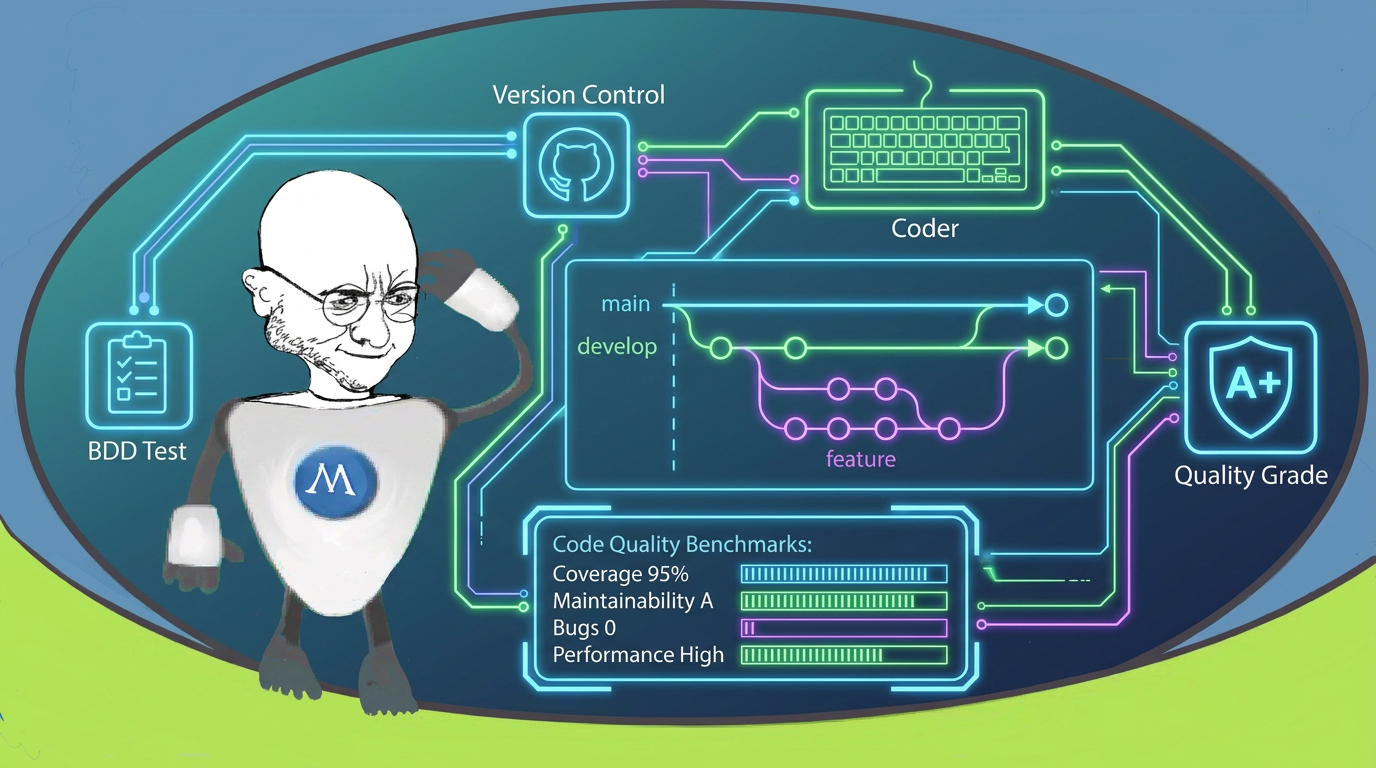
A Day in the Life of an Agentic Engineering System
Beyond the Single-Prompt Paradigm
Most discussions around AI coding focus on single-turn completions: a developer types a prompt into a chat box, gets a snippet of code, pastes it into an editor, and manually verifies if it works.
In a mature, production-grade codebase, code generation is only a fraction of the total engineering effort. Real software delivery requires version control discipline, issue tracker synchronization, BDD test suites, architectural design verification, automated quality benchmarking, and technical debt logging.
When AI is integrated into this real-world environment, a single monolithic model cannot safely perform all these roles. Instead, the workflow relies on orchestrated specialist subagents—each equipped with specific domain tools, deterministic constraints, and isolated execution scopes.
Here is a raw, terminal-level transcript of what a real working session looks like inside an agentic engineering harness.
Act I: Merging and Synchronizing State
The session begins with the developer completing work on ticket LOS-63. Rather than executing manual Git commands and updating issue trackers, the developer issues a single high-level command:
> Please commit and push the current branch and create a merge request for me to merge into integration
The primary orchestrator processes the intent and dispatches a dedicated version-control-agent:
● Agent(version-control-agent: Version Control Specialist)
  Subagent version-control-agent has been deployed to commit, push feature/LOS-63,
  and create the merge request into integration.

  • Branch: feature/LOS-63 pushed to origin
  • Merge Request: !66 (feat(supervisor): introduce the Deterministic Supervisor framework)
  • Time Logged: 5m on GitLab Issue #62 (total 35m)
Notice what occurred in those few seconds:
- The subagent committed and pushed
feature/LOS-63. - It created Merge Request
!66targeting theintegrationbranch with standard conventional commit messaging. - It authenticated with the GitLab API (
glab) to log 5 minutes of spent time directly against Issue#62.
Act II: Context-Aware Branch Transition
Once the merge request is approved, the developer instructs the system to reset local state and prepare for the next task:
> Code merged. Please pull integration, delete merged branch and create next branch
The system does not blindly guess the next branch name. It queries the live GitLab issue tracker via CLI commands (glab issue list), evaluates active sprint priorities, and presents a recommendation:
? `integration` branch has been updated and `feature/LOS-63` deleted.
  Which ticket or feature branch would you like to create next?
  > (Recommended) Create feature/LOS-64
Upon user confirmation, the version-control-agent checks out feature/LOS-64.
Next, the developer asks the agent to read and confirm requirements for ticket LOS-64:
> read LOS-64 and confirm it is clear
The agent executes glab issue view 63, logs its operational time, and synthesizes a structured scope confirmation:
### Summary & Clear Goal Confirmation
• Goal: Integrate DeterministicSupervisor with the EngineeringHarness workflow catalog
• Scope & Key Deliverables:
  1. Implement WorkflowRegistry in src/supervisor/ with predefined templates.
  2. Enhance DeterministicSupervisor to execute named workflows.
  3. Extend CLI entry point: engineering-harness supervisor run <workflow-name>.
  4. Create BDD acceptance suite in tests/acceptance/supervisor/.
  5. Ensure 100% pass rate across workspace (766+ existing + new tests passing).
  6. Produce Radon quality benchmark report and update technical debt ledger.
Act III: Orchestrating the Specialist Pipeline
With the scope validated, the developer gives a one-word instruction:
> proceed
This single command triggers a multi-stage, multi-agent pipeline where specialist subagents execute sequentially and concurrently:
                      [Orchestrator]
                            │
       ┌────────────────────┼────────────────────┐
       │                    │                    │
       ▼                    ▼                    ▼
┌─────────────┐      ┌─────────────┐      ┌─────────────┐
│ Design      │ ──►  │ BDD Test    │ ──►  │ Python      │
│ Architect   │      │ Specialist  │      │ Coder       │
└─────────────┘      └─────────────┘      └─────────────┘
                                                 │
                                                 ▼
                                          ┌─────────────┐
                                          │ Full Pytest │
                                          │ (766+ tests)│
                                          └──────┬──────┘
                                                 │
                                                 ▼
                                          ┌─────────────┐
                                          │ Code Grade  │
                                          │ & Debt Log  │
                                          └─────────────┘
1. Architectural Specification
The software-design-python-agent is deployed to design module contracts and specifications for WorkflowRegistry in src/supervisor/.
2. Behavior-Driven Development (BDD)
Before any production code is written, the bdd-scenario-designer-agent creates Gherkin feature files (supervisor_harness_integration.feature) and step definitions in tests/acceptance/supervisor/.
3. Implementation & Verification
The coder-agent-python implements src/supervisor/registry.py and unit tests in tests/unit/supervisor/test_registry.py. It then executes the full workspace pytest suite—verifying all 766+ tests pass without regression.
4. Quality Grading & Debt Logging
Once tests pass, two specialized governance agents deploy:
code-grading-agent: Runs Radon cyclomatic complexity and maintainability metrics against the new code, posting the benchmark report directly to GitLab Issue#63.technical-debt-handling-agent: Evaluates new abstractions against the project’s technical debt ledger and updates engineering documentation.
Key Takeaways from Agentic Engineering
Living alongside autonomous coding agents reveals several foundational truths about modern AI engineering workflows:
- Separation of Concerns: Asking one prompt to design, code, test, document, and manage Git leads to context overload and silent errors. Specialist subagents keep context clean and deterministic.
- Tooling Integration: Agents must operate directly with native developer tools (
git,glab,pytest,radon,ruff). Chat interfaces without tool execution are merely speculative. - Automated Governance: Quality checks (BDD suites, pytest pass rates, complexity benchmarks, debt ledgers) must run automatically at machine speed. Human oversight shifts from line-by-line micromanagement to high-level intent orchestration.
When AI agents are bound to rigorous engineering harnesses, software delivery shifts from chaotic code generation to reliable, repeatable production.