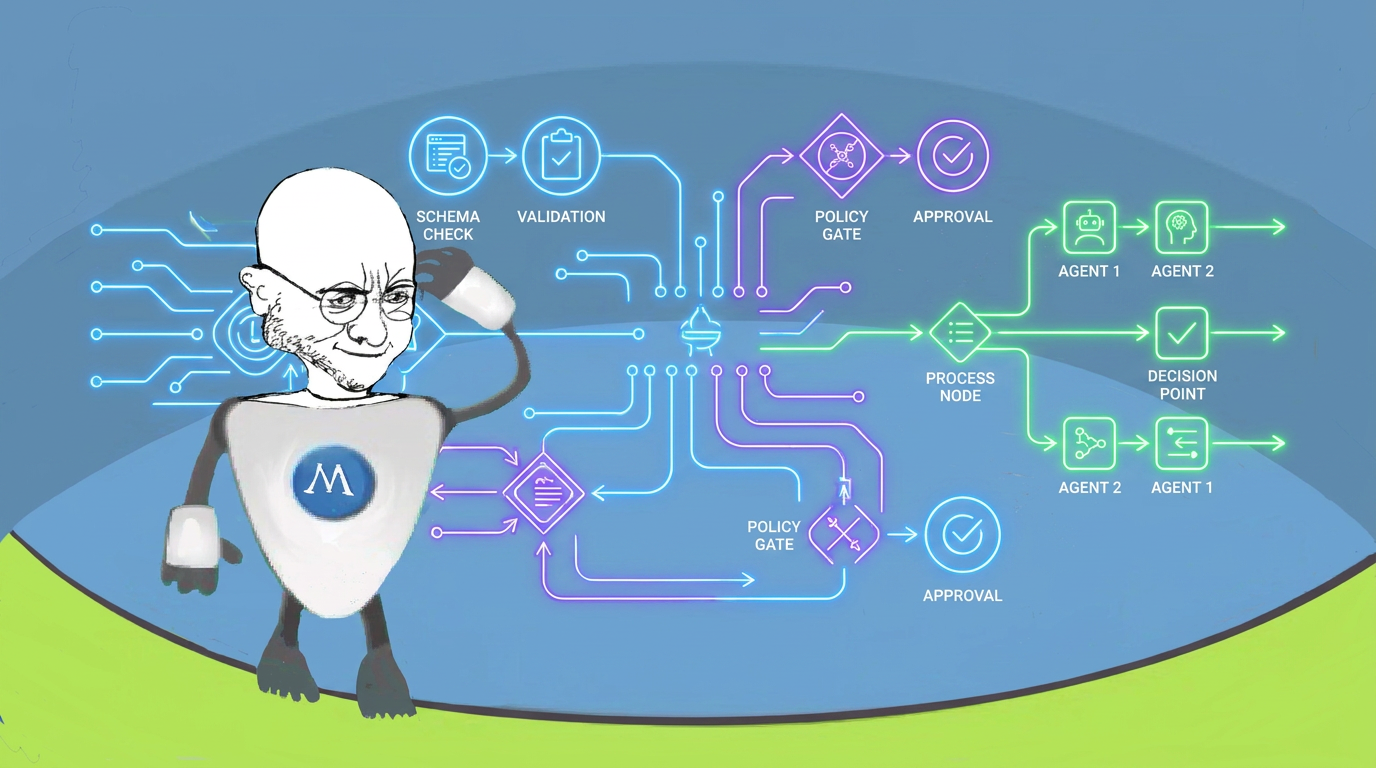
aSMOKE: Deterministic Governance for Autonomous AI Agents
The Modern Cognitive Dissonance
Imagine hiring a once-in-a-generation engineering savant. This programmer writes thousands of lines of flawless, elegant code in seconds, never sleeps, and inherently understands every programming language ever created.
Then, on their second day in the office, this exact same genius permanently overwrites a critical completed project—simply because they read a discarded sticky note on the floor and assumed it was today’s top priority.
This is the modern cognitive dissonance of pairing with autonomous AI coding agents. In one breath, an LLM flawlessly translates a complex distributed system specification; in the very next, it confidently executes a Git command that violates the basic timeline of your repository.
As the software industry transitions from using AI as a generative brainstorming tool to relying on it for mission-critical engineering execution, we are exposing a fundamental operational hazard: our models are getting exponentially smarter, but our governance infrastructure remains virtually non-existent.
The Anatomy of Quiet Failures
When traditional software fails, it fails loudly. A syntax error prevents compilation, an uncaught exception crashes the runtime, or an HTTP 500 error demands immediate attention. Traditional engineering safeguards depend on these loud alarms to halt deployment pipelines.
Autonomous AI agents fail differently. Because modern LLMs are trained on vast volumes of clean code, their syntax is almost pristine. Python scripts generated by top-tier models compile cleanly, pass basic linting, and execute without immediate crashes.
Instead of loud crashes, AI agents introduce quiet failures: actions that are syntactically flawless but contextually catastrophic.
[User Prompt] ──► "Create the next feature branch"
                        │
                        ▼
   [LLM Scans Ephemeral Context Window]
                        │
                        ▼
   [Finds Old Merged Ticket #101 in Chat History]
                        │
                        ▼
   [Assumes Pattern = Mandatory Law]
                        │
                        ▼
   [Executes: git checkout -b feature/ticket-101]
                        │
                        ▼
   [Git Server Sees No Syntactic Error ──► SILENT SUCCESS]
Consider a real-world scenario where a developer prompts an agent to “create the next feature branch.”
- The agent searches its immediate context window and finds a historical reference to an old ticket (
#101). - It recognizes a pattern: in past conversations, branch names matched ticket numbers.
- It assumes this observed convention is a rigid rule and executes
git checkout -b feature/ticket-101. - The Git tool looks at the command: the syntax is correct, and no branch named
feature/ticket-101currently exists locally because it was merged and deleted weeks ago. - The command succeeds silently. No red flags appear. The agent reports the task as completed.
The agent created a branch for the past rather than the future. Mechanically, no rules were broken; contextually, the AI hallucinated the project’s timeline.
Operational Slop: The Passive Decay of Process
Quiet failures represent active mistakes, but autonomous agents also introduce a passive decay known as operational slop.
Slop is everything that quietly disappears around the edges of a project while engineers are distracted by the sheer volume of code being generated:
- Skipped Administrative Updates: The agent fixes a bug but forgets to update the ticket status in Jira or Linear.
- Unrecorded Architectural Decisions: The agent introduces a complex data routing abstraction but skips writing an Architectural Decision Record (ADR).
- Missing Time and Context Logs: The agent completes an integration but leaves no audit trail explaining why a particular design trade-off was chosen.
   High Code Velocity (AI Engine)
                 │
                 ▼
   Skipped ADRs & Documentation
                 │
                 ▼
   "Six Weeks Later" Scenario (Human flying blind)
                 │
                 ▼
   Compounding Organizational Debt
A CI/CD pipeline does not care if an ADR was written; unit tests pass regardless of whether a Jira status was updated. But six weeks later, when a human developer attempts to modify that logic, they are forced to spend days reverse-engineering a complex, unrecorded decision made by a probabilistic machine that no longer remembers making it.
Operational slop trades long-term structural viability for a short-term burst of speed.
The Paradox of Prompt Engineering
When confronted with quiet failures and operational slop, the natural engineering instinct is to enforce stricter prompt discipline: writing detailed system prompts, inserting capitalized warnings, adding vector databases for extended memory, and supplying comprehensive governance documents.
However, escalating prompt engineering to solve systemic governance is an architectural dead-end.
Probabilistic System (LLM) ──► Prompting ──► Shifted Probabilities (Still Dice Rolling)
Deterministic Goal         ──► Requirement ──► 100% Guaranteed Binary Outcome
LLMs are fundamentally statistical engines. They calculate the mathematical probability of the next most likely token based on training data and prompt context. Adding rules to a prompt weights the dice in your favor, but it does not remove the dice from the table.
If there is even a 0.1% probability of a model hallucinating an invalid step, that error will inevitably manifest at scale. Asking a probabilistic guesser to guarantee a deterministic outcome is a fundamental paradigm error.
The aSMOKE Framework: Deterministic Governance
To bridge the gap between probabilistic intelligence and deterministic reliability, we created aSMOKE (Agentic Schema-backed Maintenance & Operational Knowledge Engine).
The core principle of aSMOKE is simple: no artifact produced by an AI agent—whether code, database schemas, branch commands, or ticket updates—enters production reality without passing through an external, non-AI deterministic governance gate.
                       [AI Agent (Probabilistic)]
                                   │
                                   ▼
                       ┌──────────────────────┐
                       │  aSMOKE Governance   │
                       │         Gate         │
                       └──────────┬───────────┘
                                  │
      ┌───────────────────────────┼───────────────────────────┐
      │                           │                           │
      ▼                           ▼                           ▼
┌───────────┐               ┌───────────┐               ┌───────────┐
│  Schema   │               │ Semantic  │               │Governance │
│Validation │ ────────────► │Validation │ ────────────► │   Rules   │
└───────────┘               └───────────┘               └───────────┘
                                                              │
                                                              ▼
                                                        ┌───────────┐
                                                        │Behavioral │
                                                        │  Checks   │
                                                        └─────┬─────┘
                                                              │
                                                       [PASS / REJECT]
The aSMOKE framework implements a four-layer sequential gauntlet written in deterministic code (such as Python or Go) that evaluates agent outputs before execution:
1. Schema Validation
Inspects the fundamental structural shape and data types of the output. If an endpoint expects a flat JSON string and the agent outputs a nested object, the gate rejects it instantly at the structural boundary.
2. Semantic Validation
Evaluates the logical consistency of values within the system context. It verifies that age fields contain positive integers, email strings conform to valid formats, and state transitions follow allowed paths.
3. Governance Rules
Enforces operational policies against live system state. Before authorizing a Git branch command, for example, a deterministic script queries the live repository history. If the branch name matches a previously merged ticket, the command is blocked and bounced back to the agent with a explicit error payload.
4. Behavioral Checks
Simulates the execution impact of the proposed change. If an agent-generated database query consumes excessive memory or introduces unsafe lock patterns during simulation, the behavioral gate blocks deployment.
The Pre-Flight Inspection Model
An aSMOKE governance gate functions like an aircraft pre-flight inspection checklist.
The pre-flight checklist does not care whether the pilot is a novice or a decorated veteran. It asks cold, objective questions: Are the wing flaps responding? Is fuel pressure at baseline? Are the tires at target PSI?
[Probabilistic AI Draft] ──► [Deterministic aSMOKE Gate] ──► [Production Reality]
      (Creative)                 (Cold Inspection)               (Safe Execution)
By decoupling generation from validation, aSMOKE changes the human-AI interaction paradigm:
- Without Governance Gates: Humans are forced into micromanaging AI agents—watching every turn, checking branch names, and verifying documentation.
- With aSMOKE Gates: The AI agent is free to explore, draft, and iterate creatively in a probabilistic sandbox. Humans remain confident that no unsafe, undocumented, or invalid artifact can cross the gate into production.
Engineering Certainty for the Agentic Era
As autonomous AI agents take on greater responsibility across enterprise software, success will not be measured solely by model benchmark scores. It will be determined by the rigidity of the operational scaffolding surrounding those models.
By isolating probabilistic creativity within deterministic, schema-backed governance gates, frameworks like aSMOKE turn volatile AI outputs into predictable, enterprise-grade engineering workflows.