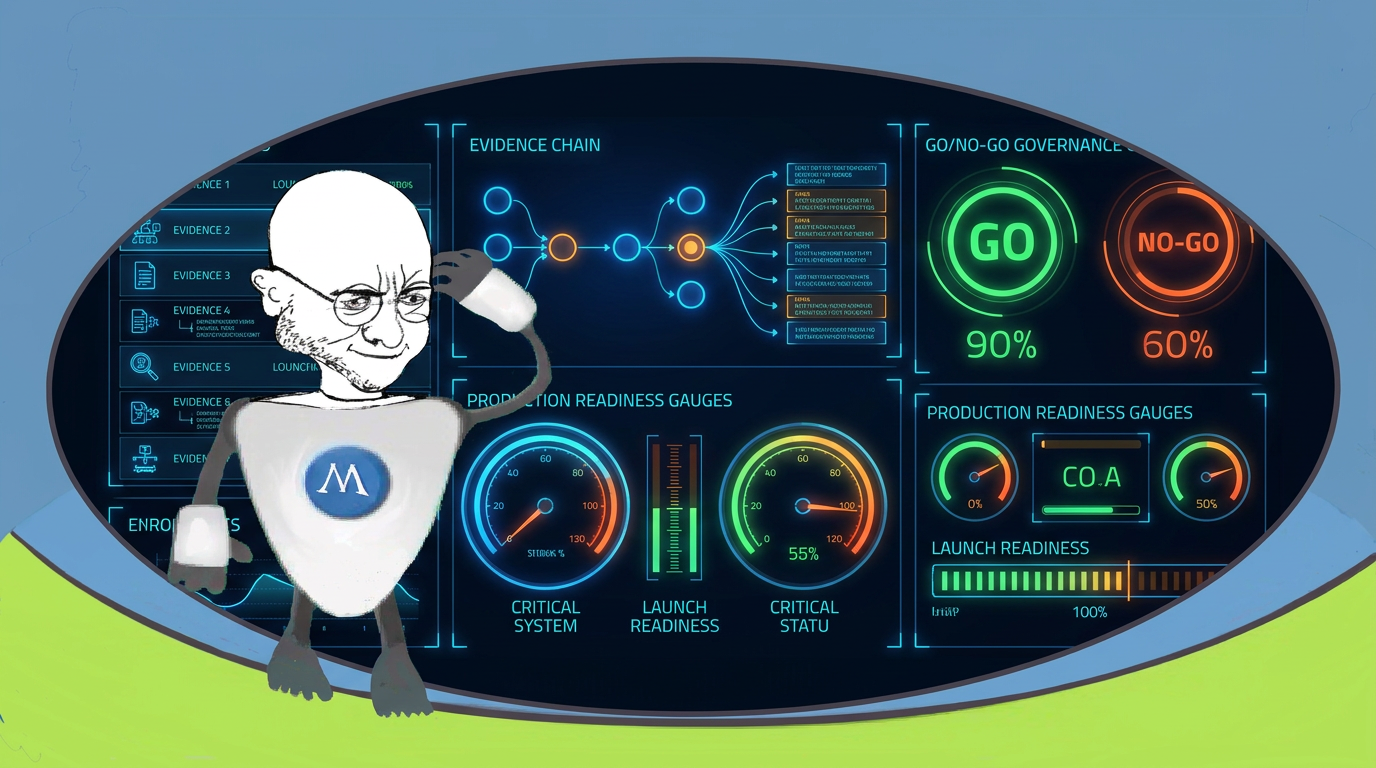
The Evidence-Driven Engineering Console: Shifting AI Workflows from Activity to Proof
The Paradigm Shift in Engineering Dashboards
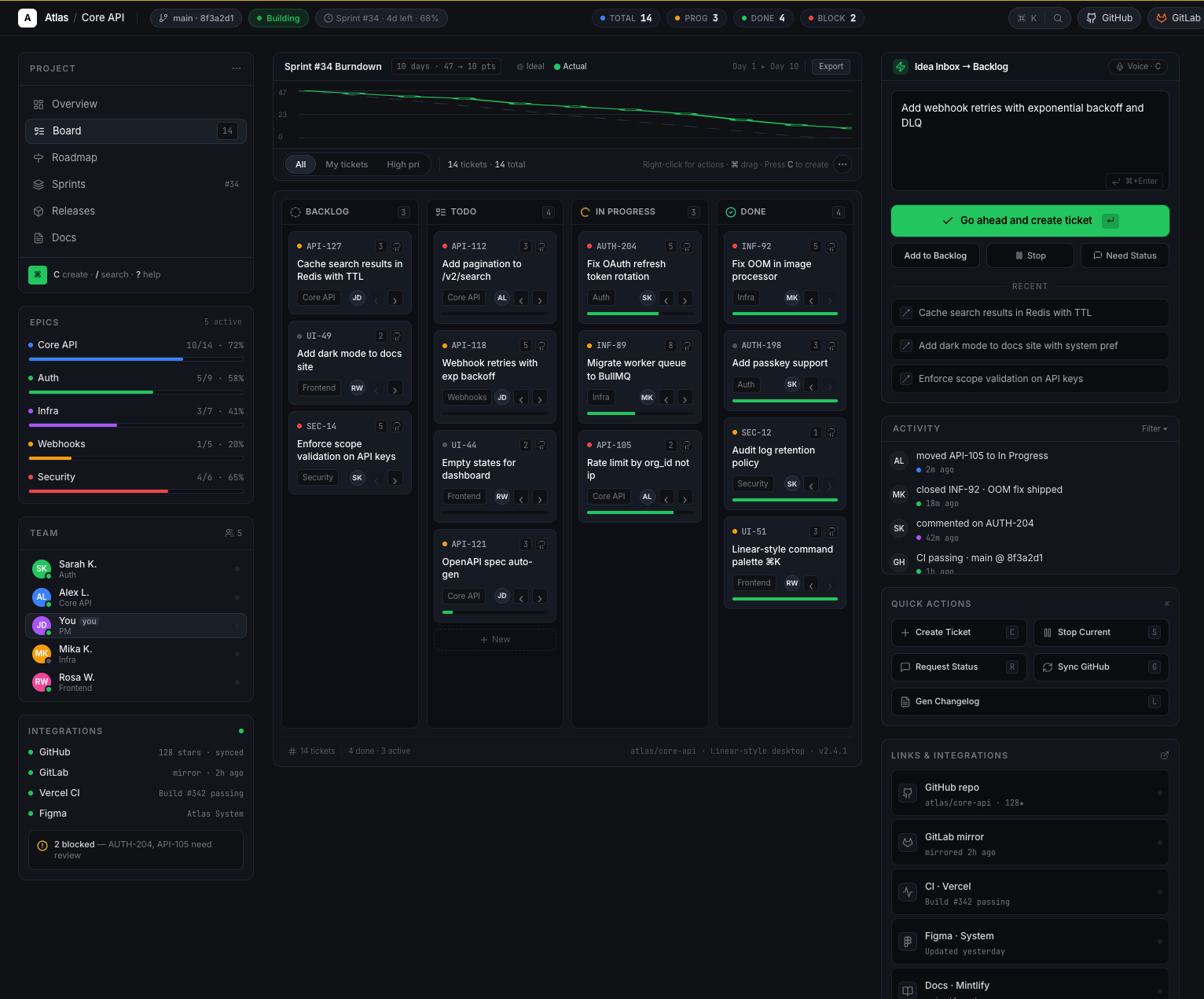
Conventional project management dashboards (like Jira or Trello) are designed around human activity:
- What are people working on?
- How many tickets are in progress?
- What is our sprint velocity?
In a traditional software team where writing code is slow and manual, tracking human activity serves as a proxy for progress.
However, when autonomous AI agents enter the engineering workflow, code generation becomes virtually instantaneous. Activity is cheap, velocity is intoxicating, and ticket status updates become meaningless if the underlying abstractions are fragile or flawed.
When pairing with AI agents, the center of gravity must shift from activity to proof.
Conventional Dashboard:
   What are people working on? ──► Ticket Counts & Velocity

Evidence-Driven Console:
   What has been proved?       ──► Verifiable Evidence Chains & GO/NO-GO Gates
An Evidence-Driven Engineering Console asks fundamentally different operational questions:
- What engineering intent exists?
- What has been deterministically proved?
- What is blocked by missing verification?
- What evidence supports production readiness?
The Five Questions of Evidence-Driven Systems
At any given moment, an engineering leader or developer inspecting a system should receive immediate, transparent answers to five questions:
1. What are we trying to build?         (Intent & Specification)
2. What state is each feature in?         (Lifecycle Stage)
3. What evidence currently exists?       (Audit & Test Verification)
4. What is preventing safe progress?     (Governance Blockers)
5. What deterministic action comes next?  (Allowed State Transitions)
By structuring the engineering console around these questions, teams eliminate the ambiguity of “80% done” features.
Deconstructing the Evidence-Driven Control Surface
To turn autonomous AI execution into a predictable pipeline, the control surface is organized into four core operational layers:
1. Programme State
Top-level metrics reflect system health and governance rather than superficial ticket counts.
Instead of displaying Total Tickets or Points Completed, the console surfaces:
ACTIVE WORKFLOWS:        3 (2 executing · 1 awaiting human approval)
GOVERNANCE STATE:        PASS (12/12 mandatory checks satisfied)
PRODUCTION READINESS:    74% (3 evidence gaps remain)
TECHNICAL DEBT:          4 items due · 2 overdue
Every percentage or status is clickable and traceable directly to underlying artifacts. A readiness score of 74% is not a subjective estimate; it means specific acceptance tests or linting gates remain unverified.
2. Real Lifecycle Flow
Features move through a rigorous, full-lifecycle progression rather than a simple three-column board:
Idea ──► Specification ──► Ready for Build ──► In Development ──► Verification ──► Ready for Release ──► Production
Each feature card surfaces granular verification states across multiple dimensions:
LOS-65: Externalise Supervisor Policies

SPECIFICATION:    PASS
ARCHITECTURE:     APPROVED
IMPLEMENTATION:   62%
TESTS:            18/24 Passing
GOVERNANCE:       PENDING
RISK LEVEL:       MEDIUM

Current Agent:   coder-python-agent
Current Action:  Implementing policy loader
Last Evidence:   4 minutes ago
3. The Live Evidence Rail
The core differentiator of an evidence-driven console is the Live Evidence Rail—a real-time, immutable stream of every execution step, policy evaluation, and harness invocation:
12:42  Supervisor selected workflow `implement-ticket`
12:42  Policy `require_acceptance_tests` evaluated: PASS
12:43  Harness invoked `validation pytest`
12:46  766 tests passed
12:46  Ruff gate failed: 30 violations
12:47  Workflow paused
12:47  Human approval requested
Each entry in the log links to a complete Evidence Chain:
Decision ──► Policy Check ──► Execution ──► Result ──► Evidence Artifact
Every step records the initiating objective, correlation ID, exit codes, stdout/stderr, files changed, and the specific agent or harness responsible.
4. Deterministic Action Surfaces
In a traditional UI, a user is presented with static, universal buttons like “Run” or “Deploy”.
In an evidence-driven console, the interface is a direct projection of the Supervisor State. The system calculates allowed state transitions and surfaces only the actions that are valid for the current feature state:
Available Actions:
  [Run Acceptance Suite]
  [Perform Governance Check]
  [Request Architectural Review]

Blocked Actions:
  [Prepare Merge Request] ──► Blocked: 2 acceptance tests failing
  [Approve Release]       ──► Blocked: Technical debt item TD-0034 unresolved
The Feature Journey: Full-Cycle Visibility
Every ticket features a dedicated Feature Journey page showing its complete lifecycle from raw idea to production observation:
LOS-65 — Externalise Supervisor Policies

Idea
  ✓ Captured and structured

Specification
  ✓ Ticket approved & inputs defined

Architecture
  ✓ Policy boundary approved

Implementation
  ● In progress (14 files changed)

Verification
  ✓ Unit tests
  ✓ Acceptance tests
  ✕ Static analysis (Ruff)
  ○ Import boundary check

Release
  ○ Merge request & candidate build

Operations
  ○ Post-release verification & lessons learned
The Defensible GO / NO-GO Gate
At the center of the control surface lies a single, unmistakable governance result:
aSMOKE GOVERNANCE RESULT: NO-GO

Passed: 17  |  Failed: 2  |  Warnings: 4  |  Skipped: 0

Blocking Failures:
  ✕ Acceptance behaviour is not fully covered
  ✕ Supervisor package missing from Poetry configuration

Required Action:
  Resolve TD-0034 or explicitly log an approved risk exception.
There are no ambiguous health indicators. The system provides a defensible GO, NO-GO, or GO WITH ACCEPTED RISK decision backed by hard evidence.
Distinguishing Roles Across the Stack
An evidence-driven system visually separates responsibilities across the entire operational stack:
- Human Judgement: Strategic intent, risk acceptance, and final release approvals.
- Agent Reasoning: Feature drafting, code generation, and test creation.
- Supervisor Decision: Calculating valid state transitions and enforcing policy boundaries.
- Harness Execution: Running deterministic commands (
pytest,ruff,radon) in isolated environments.
By making this distinction explicit, teams gain complete visibility into who—or what—is driving every change in the codebase.