From Job Haunted to Job Hunted: A Personal Journey Through Redundancy, Fear, and Reinvention at 62
Shortly after my sixty-first birthday, I was invited into a scheduled meeting with HR. The conversation was polite, formal, and brief. My role was being made redundant.
After more than four decades working in technology, I had never struggled to find employment. I had built systems, led teams, weathered industry shifts, and accumulated a substantial track record. My immediate internal reaction was not panic, but a quiet, misplaced confidence. I assumed that finding another position would simply be a matter of circulating my CV, having a few conversations, and choosing the right offer within a couple of months.
When I got home and told my wife, she burst into tears.
I remember being surprised by her distress. I thought she was overreacting. What I had not yet understood—and what she had instinctively sensed—was that the employment landscape had undergone a structural convulsion. The market I remembered from a decade earlier no longer existed.
Over the eighteen months that followed, I submitted roughly 365 job applications. The vast majority vanished into automated recruiting silences. A couple of dozen produced preliminary screening calls. A handful led to technical assessments and multi-stage interviews that ultimately went nowhere. With every passing month, savings dwindled, confidence eroded, and an insidious psychological weight began to settle in.
This article is the account of what happened during that prolonged search, the psychological traps that nearly derailed me, and the deliberate system I built to climb out of them. It is written especially for experienced professionals—particularly those in the second half of their careers—who find themselves blindsided by redundancy, haunted by the fear that their skills are obsolete, and struggling to regain traction in an unfamiliar, automated, and fiercely competitive job market.
The central thesis is straightforward: You cannot control the job market, but you can continually improve how you compete in it.
Equally important is the distinction between cause and agency: Accepting responsibility for your response is not the same as accepting blame for your circumstances. Economic contraction, algorithmic filtering, age bias, and technological disruption create genuine friction. Acknowledging those realities is essential; surrendering your agency to them is fatal.
Part I: The Reality of a Changed Employment Market
When you have spent twelve or fifteen years inside a stable company, your mental model of recruitment freezes in time. You assume hiring managers read CVs carefully, that deep domain experience is universally prized, and that a solid track record speaks for itself.
Stepping into the current market is a sobering shock. Several structural forces have combined to fundamentally alter how hiring operates:
1. Globalised and Remote Competition
Remote and hybrid work arrangements have widened the candidate pool by orders of magnitude. A role that previously drew forty applicants from Greater London now attracts four hundred applicants from across the continent. When friction drops to zero, applicant volume explodes.
2. Algorithmic Filtering and ATS Gates
Before any human eye touches an application, automated applicant tracking systems parse, score, and rank keywords against job specifications. If your CV relies on nuanced narrative rather than explicit semantic alignment, you are filtered out before the conversation begins.
3. Rapid Capability Disruption
Artificial intelligence is not merely changing the tools candidates use; it is fundamentally altering what organisations expect their staff to produce. Deep historical familiarity with legacy tooling does not automatically translate into perceived relevance for organisations racing to build modern, agentic, automated workflows.
4. Impersonal, High-Volume Sifting
Recruiters and hiring managers facing hundreds of submissions per role are forced to rely on coarse heuristics. Rejection templates arrive automatically, often within minutes of applying, offering no diagnostic feedback whatsoever.
Activity Versus Progress
In response to this wall of silence, the natural instinct is to increase volume. You apply for five jobs a day, then ten, then twenty. You refresh job boards compulsively. You click “Easy Apply” until your fingers ache.
It feels like hard work. It provides an illusion of productivity. But activity is not progress.
Sending 300 generic applications into an automated funnel is not 300 opportunities; it is one flawed experiment repeated 300 times. If an approach produces zero traction across fifty attempts, repeating it another two hundred times is an exercise in exhaustion, not strategy.
The critical diagnostic question every jobseeker must confront is: Are you simply applying for more jobs, or are you actively becoming more competitive for the right ones?
Part II: The Psychology of Unemployment
The financial cost of redundancy is obvious and quantifiable: burn rate, runway, essential outgoings, mortgage commitments.
The emotional and psychological cost is far less visible, rarely discussed openly, and significantly more dangerous to an effective job search.
Fear and the Loss of Safety
The first reaction is primal survival anxiety. What happens when severance runs out? How long can our savings sustain us? What if the market never picks up? This fear operates on the nervous system like background static, draining energy, disrupting sleep, and impairing executive function.
Shame and the Burden of Experience
For an early-career worker, redundancy is an inconvenient setback. For someone with thirty or forty years of professional standing, redundancy can feel like an indictment.
You begin to ask yourself questions that carry heavy emotional baggage:
- Have I quietly become obsolete without noticing?
- Is my age an invisible barrier that immediately disqualifies me?
- What do my former colleagues and peers think?
- How do I look my family in the eye when another month passes with zero income?
This shame produces social withdrawal. You avoid networking events because you dread the inevitable opening question: “So, what are you working on these days?”
The Collapse of Professional Identity
When you spend decades as a principal engineer, architect, director, or specialist, your identity fuses with your title. People sought your counsel. You made consequential decisions. Your calendar was full because your judgement mattered.
Redundancy strips that away overnight. Suddenly, you are not an authority; you are an unread entry in an ATS database, pleading for a fifteen-minute screening call with a twenty-four-year-old recruiter who has never worked in your discipline. The sudden loss of perceived status is disorienting and humiliating.
The Vulnerability of Honest Self-Assessment
In Daring Greatly, Brené Brown defines vulnerability not as weakness, but as the courage to show up when you cannot control the outcome. In the context of a prolonged job search, vulnerability means admitting that the skills that made you successful ten years ago may no longer be sufficient.
It is painful to look in the mirror and acknowledge: My technical knowledge has drifted. My interview technique is rusty. My communication is unfocused. I do not understand modern AI tooling well enough to lead initiatives.
Facing those deficiencies requires vulnerability. But without that clear-eyed assessment, no meaningful adaptation can occur.
Editorial Note: Experiencing fear, grief, embarrassment, and self-doubt after redundancy is not pathology. It is the completely normal human response to the sudden loss of livelihood and identity. Acknowledging these feelings is not weakness; it is the necessary baseline for regaining composure.
Part III: Two Dangerous Traps
Before you can build an effective search strategy, you have to recognise two psychological traps that systematically undermine jobseekers under pressure.
Trap 1: The Urgency Trap (When Panic Destroys Precision)
The more urgently you need money, the harder it becomes to conduct a disciplined search.
When savings are depleting, panic demands immediate resolution. You cannot tolerate the discomfort of waiting, so you rush.
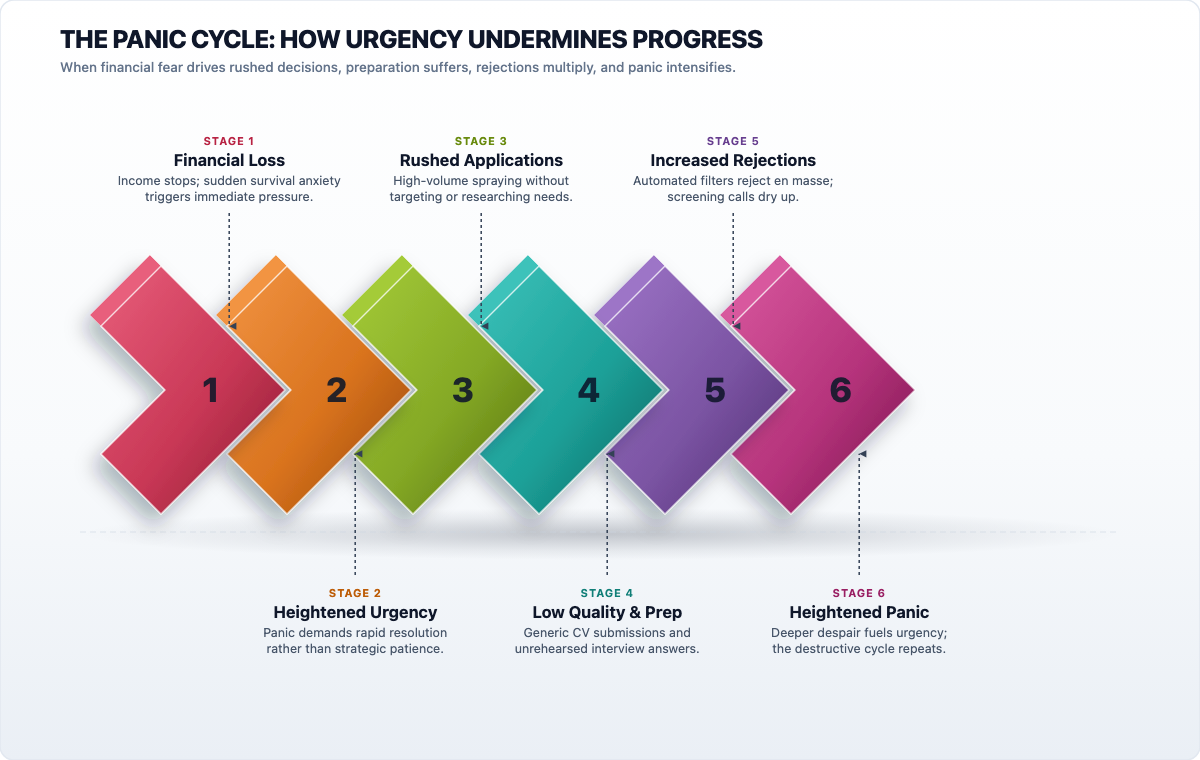
Panic manifests in specific counterproductive behaviours:
- Applying indiscriminately for roles you do not want or cannot do well.
- Skimming job descriptions without identifying the underlying operational problem.
- Neglecting background research on prospective employers.
- Attending interviews without rigorous preparation, hoping to “wing it” on past experience.
- Communicating defensively or over-talking under nervous tension.
- Refusing to take time out to learn new technologies because “learning isn’t applying.”
The counterintuitive remedy is strategic patience alongside financial urgency.
You must separate your cash-flow management from your job-search execution. Mitigate financial pressure pragmatically—cut non-essential expenditure, seek temporary contracting, freelance work, or interim employment where feasible. But when you sit down to compete for a serious professional role, you must approach it with the deliberate calculation of a long-term campaign.
Panic is not a strategy. Urgency cannot be allowed to dictate your standards of preparation.
Trap 2: Learned Helplessness (When Explanations Become Excuses)
Spend ten minutes on LinkedIn or Reddit and you will be inundated with despairing narratives:
- “Nobody is hiring.”
- “AI is destroying all software jobs.”
- “If you are over 50, you are completely unemployable.”
- “The whole recruitment system is a broken scam.”
Many of these complaints point to real friction: age bias exists; applicant tracking software is often clunky; hiring processes can be maddeningly opaque.
The fatal danger is when a valid observation of an external obstacle turns into learned helplessness—the psychological conviction that because you do not have complete control over an outcome, your actions have zero influence.
Consider the profound difference between these two internal statements:
- “AI and automation are radically reshaping how engineering teams hire and operate.” (An objective observation inviting curiosity, research, and adaptation.)
- “AI has made my experience useless and left me unemployable.” (A defeatist conclusion that justifies giving up.)
The first prompts you to open an IDE, spin up an API key, and learn modern frameworks. The second gives you permission to stop trying.
You cannot force an employer to hire you. But you can determine whether your CV provides demonstrable evidence of value. You can determine whether your interview answers are rambling or razor-sharp. You can determine whether you learn tomorrow’s tooling or cling to yesterday’s credentials.
An explanation for your circumstances must never become an excuse to surrender your agency.
Part IV: The Turning Point
The turning point in my own eighteen-month search arrived on a grim Tuesday afternoon after yet another final-round rejection.
I was angry. I felt aggrieved that my decades of experience, loyalty, and deep engineering knowledge were being brushed aside by companies that seemed obsessed with shallow buzzwords.
Then a familiar phrase occurred to me, adapted from John F. Kennedy’s famous inaugural address:
Ask not what the job market can do for you. Ask what you can do for the job market.
It sounded harsh, almost offensive at first. But it forced a radical, necessary shift in perspective.
Up to that point, my mental posture had been entirely self-referential:
- Why won’t anyone give me an interview?
- Why don’t they see how experienced I am?
- Why is the market so unfair to older engineers?
Every one of those questions centered on my needs, my grievance, and my past.
Employers do not hire candidates to solve the candidate’s financial problems or validate their career history. Employers hire people to solve their acute, expensive, and stressful operational headaches.
The questions I needed to ask were outward-facing:
- What specific commercial and technical problems are modern engineering organisations struggling to solve right now?
- Which of those problems do my capabilities address directly?
- Where are my skills genuinely deficient, and what must I learn to become credible?
- What tangible evidence can I present that proves I can deliver value from week one?
- What specific mistakes did I make in my last three interviews, and how will I correct them?
Being made redundant was not my fault. The state of the economy was not my fault. But how I prepared, how I adapted, and how I competed in the market were entirely my responsibility.
Part V: The Practical Job-Search Framework
Restoring agency requires replacing unstructured emotional effort with a systematic engineering process. The framework below breaks down into five deliberate disciplines.
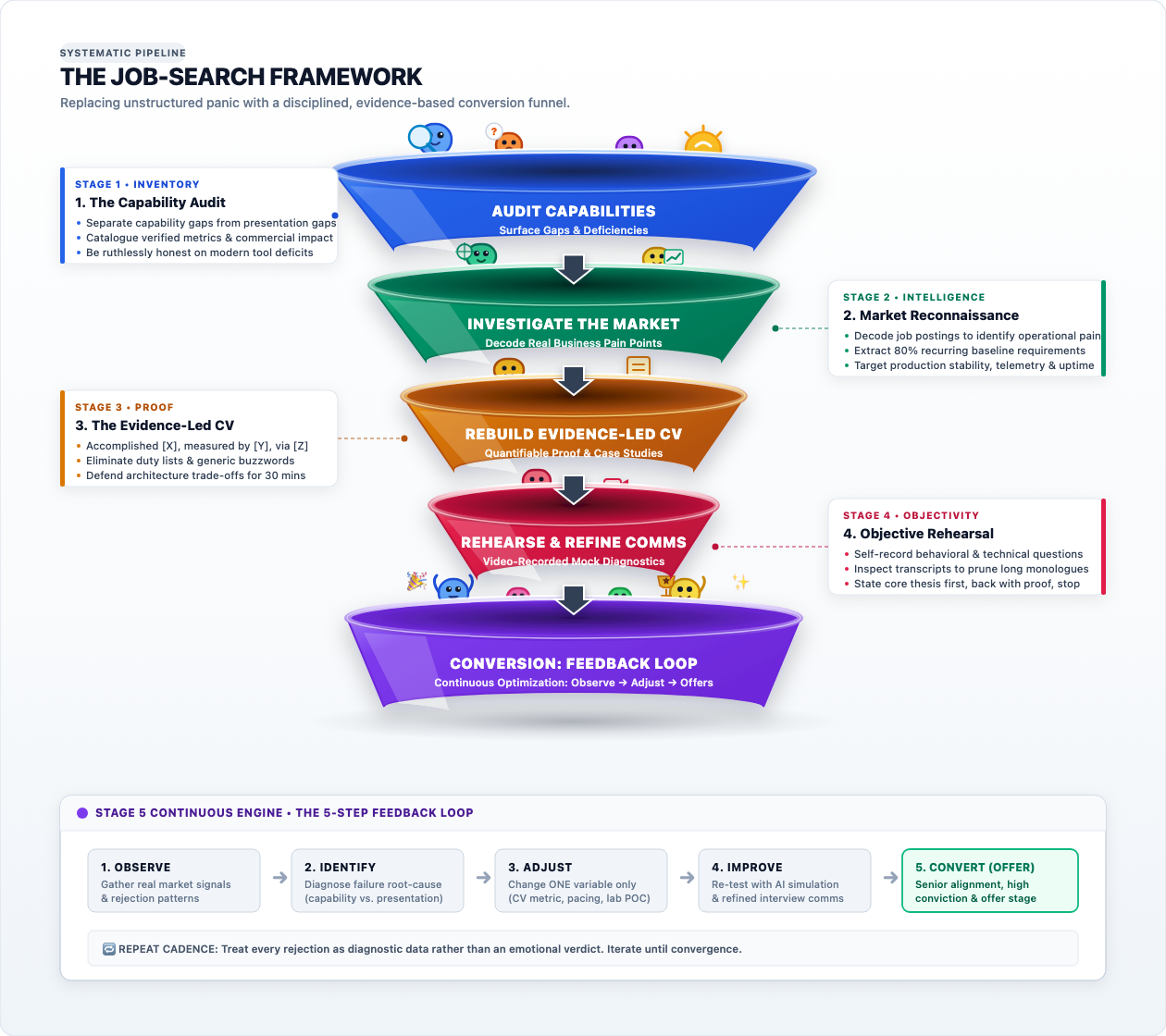
1. The Capability Audit: Separating Substance from Presentation
Before sending another application, conduct an uncompromising audit of your professional inventory.
Take a blank document and split your experience into two columns:
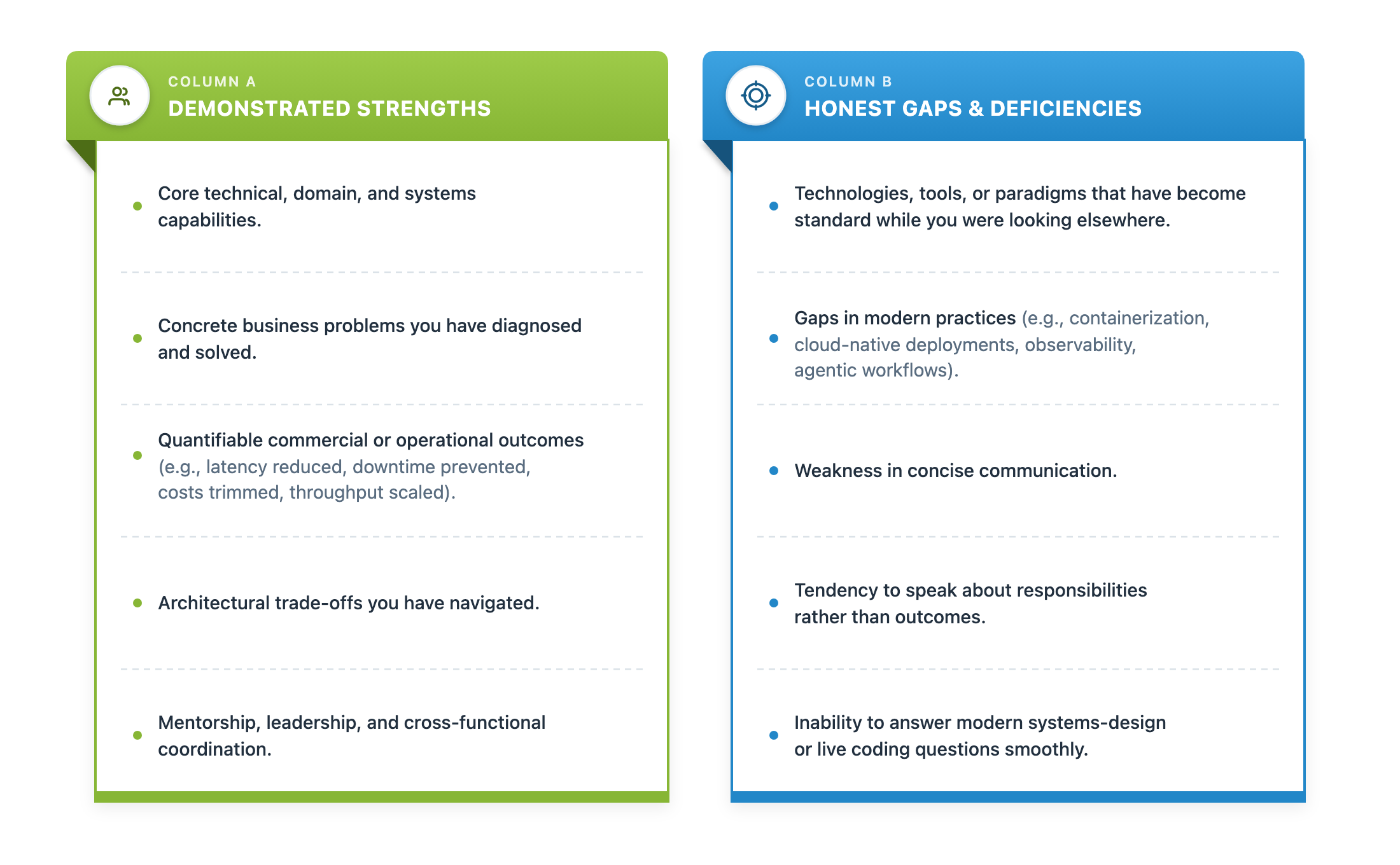
Capability Versus Presentation
Critically distinguish between a gap in capability and a gap in presentation.
- If an employer requires production experience with distributed vector databases and you have never used one, that is a capability gap. You must study, build, and experiment before claiming competence.
- If you have built complex distributed caching layers for a decade but your CV describes it as “Maintained backend systems,” that is a presentation gap.
Do not try to fix a presentation gap with more courses. Do not try to fix a capability gap with better buzzwords. Diagnose the true failure mode.
2. Study the Market as an Intelligence Operation
A job specification is not a bureaucratic checklist; it is an open window into an organisation’s pain points.
When examining job postings across your sector:
- Look for recurring patterns: Which requirements appear across 80% of postings? Those are table stakes.
- Identify the underlying business tension: If an engineering role repeatedly emphasizes observability, OpenTelemetry, and incident reduction, the organisation is likely suffering from production instability and poor telemetry. Frame your experience around system reliability and MTTR reduction.
- Research the company before applying: Read their engineering blogs, examine their public repositories, inspect their leadership’s commentary, and understand their business model. What are their commercial pressures?
3. Rebuild Your CV Around Verifiable Evidence
A CV is not an autobiography. Its purpose is not to archive every task you have completed since 1985. Its sole purpose is to prove your relevance to a specific opportunity.
Common CV Anti-Patterns
- The laundry list: Listing forty programming languages, frameworks, and tools alphabetically without context.
- The duty list: “Responsible for developing features and attending agile ceremonies.” (This describes attendance, not impact.)
- The historic graveyard: Devoting two pages to legacy systems decommissioned twenty years ago while summarizing recent work in three bullet points.
The Evidence-Led Format
Build a comprehensive Master CV containing your full factual history. From this source, create tailored versions for specific role archetypes.
For every significant role or project, apply the strict evidence formula:
Accomplished [X], as measured by [Y], by making architectural decision [Z].
Example:
- Poor: “Worked on backend performance optimization.”
- Evidence-led: “Reduced API p99 latency from 850ms to 120ms across 14 core microservices by restructuring PostgreSQL query indexing and implementing distributed Redis caching, eliminating database lock contention during peak traffic.”
If you claim a capability, ensure you can speak fluently about the trade-offs, edge cases, and failure modes for thirty minutes under intense technical cross-examination.
4. Objective Reflection: The Recorded Interview Experiment
This was perhaps the single most uncomfortable and transformative breakthrough of my entire eighteen-month search.
After several promising second-stage interviews failed to materialize into offers, I was frustrated. I was convinced I was giving comprehensive, knowledgeable answers.
I decided to run an objective diagnostic test: I opened a video recording application on my laptop, set up a prompt of ten standard behavioral and technical questions, and recorded myself answering them in real time.
Watching the recording was agonizing.
The person on the screen was knowledgeable, but he was:
- Speaking far too quickly, radiating nervous tension.
- Talking in interminable paragraphs, delivering five-minute monologues that buried the core answer under unnecessary historical backstory.
- Failing to leave conversational pauses, effectively shutting out the interviewer.
- Sounding defensive when answering questions about unfamiliar tools.
What I thought was happening in my head was completely different from what was actually arriving across the table.
The Practice Protocol
- Record mock interviews: Use your webcam or phone. Answer questions aloud without stopping.
- Inspect transcripts: Generate an automated transcript of your answers. Count your words. Look at the ratio of signal to filler. If a question can be answered crisply in 90 seconds, why did you speak for four minutes?
- Practice structured conciseness: State the direct answer or thesis in the first sentence. Provide supporting evidence in two or three sentences. Conclude with the business outcome and stop talking.
5. AI as an Intensive Learning and Sparring Partner
Throughout this period, the popular narrative was that artificial intelligence was eliminating professional jobs. It would have been easy to view AI as the final nail in the coffin of an established engineering career.
Instead, I chose to treat AI as the most capable, patient, and uncompromising professional tutor I had ever encountered.
There was no employer paying for my retraining. There was no structured corporate curriculum. I had to build my own laboratory.
Practical Ways to Use AI in Your Search
-
Adversarial Interview Simulation: Feed an LLM a detailed job description, your complete CV, and say:
“Act as an uncompromising, senior engineering leader interviewing me for this role. Ask me one challenging technical question at a time. Drill into my assumptions, demand evidence, challenge vague assertions, and evaluate the conciseness and technical accuracy of each response before moving to the next question.”
-
CV Gap Analysis: Provide the role requirements and your draft CV:
“Identify where my CV fails to provide concrete evidence for the requirements listed in this job specification. Point out where my claims sound generic, where outcomes are missing, and what an experienced hiring manager would perceive as red flags.”
-
Accelerated Technical Deep-Dives: When encountering an unfamiliar modern tool, library, or architectural pattern:
“Explain the fundamental design trade-offs of this technology. Why was it built? What predecessor tool did it replace, and why? What are its primary failure modes in high-concurrency production environments? Provide a minimal code implementation demonstrating its core mechanic.”
-
Hands-On Demonstration Projects: Do not merely read about new technologies. Build small, fully working, observable proof-of-concepts. Write tests. Instrument them with telemetry. Document the design decisions in a clean repository. Demonstrable, running code is the antidote to skepticism about age or currency.
Part VI: The Feedback Loop (The Engine of Improvement)
The cornerstone of an effective search is the continuous feedback loop. It translates effort into compound improvement.
       ┌────────────────────────┐
       │      1. OBSERVE        │
       │ (Gather Real Signals)  │
       └───────────┬────────────┘
                   │
                   ▼
       ┌────────────────────────┐
       │      2. IDENTIFY       │
       │  (Diagnose Root Cause) │
       └───────────┬────────────┘
                   │
                   ▼
       ┌────────────────────────┐
       │       3. ADJUST        │
       │ (Make ONE Modification)│
       └───────────┬────────────┘
                   │
                   ▼
       ┌────────────────────────┐
       │      4. IMPROVE        │
       │ (Verify the Difference)│
       └───────────┬────────────┘
                   │
                   ▼
       ┌────────────────────────┐
       │       5. REPEAT        │
       │  (Compound the Gains)  │
       └────────────────────────┘
1. Observe (Gather Unvarnished Data)
Track your pipeline systematically:
- How many tailored applications yield screening calls?
- At which specific stage do conversations stall (recruiter screen, technical screen, architecture deep-dive, executive interview)?
- What questions consistently cause you to hesitate or ramble?
- What specific feedback (if any) was shared?
2. Identify (Diagnose the Mechanism)
Analyze what the data suggests without emotional overreaction:
- High application count with zero screenings indicates a targeting or CV positioning issue.
- Passing recruiter screens but failing technical screens indicates a depth, modern tooling, or live-explanation issue.
- Reaching final rounds without offers indicates a strategic alignment, communication, or executive-presence issue.
3. Adjust (Execute a Specific Change)
Never change everything at once. Make a targeted, testable modification:
- Restructure the summary and top achievements on your CV.
- Narrow your focus from “general software engineering” to a distinct niche where you hold a verifiable edge.
- Rehearse a specific behavioral or technical story until it is concise, evidence-packed, and under two minutes.
4. Improve (Test the Modification)
Evaluate the impact:
- Does the recorded answer sound more confident and precise?
- Does the revised CV generate a higher response rate across the next ten applications?
- Did you answer a difficult architecture question without drifting off-topic?
5. Repeat
Job searching is an iterative optimization problem. You do not solve it through a single heroic effort; you solve it by continually narrowing the gap between market demand and your demonstrated capability.
Part VII: Building a Lightweight Tracking System
To run this feedback loop, you need a simple, friction-free tracking system. A basic spreadsheet or Markdown ledger is all that is required.
For each serious application, record:
| Metric / Field | Purpose |
|---|---|
| Organisation & Role | Who is hiring and what is the exact title? |
| Date Applied | When was the submission made? |
| Core Problem Identified | What operational headache is this role created to fix? |
| Evidence Profile Used | Which tailored CV version and case studies were highlighted? |
| Farthest Stage Reached | Submission, Screen, Technical, Final, or Offer? |
| Toughest Questions Asked | What caught you off guard or exposed an answer that lacked crisp evidence? |
| Diagnostic Takeaway | What single adjustment must you make based on this outcome? |
The Friday Weekly Retrospective
At the end of every week, spend thirty minutes answering five questions:
- What did I learn about market demand this week?
- Which application or conversation represented my highest-quality interaction, and why?
- Where did I waste time on low-yield activity?
- What new technical or communicative capability did I build and verify?
- What are the one or two specific adjustments I will execute next week?
Focus on metrics of quality, learning, and skill development, not just gross application volume.
Part VIII: The Two Ghosts: Fear and Possibility
        THE HAUNTING GHOST                          THE GUIDING LIGHT
  ┌───────────────────────────┐               ┌───────────────────────────┐
  │ • Financial Panic         │               │ • Objective Feedback      │
  │ • Shame & Withdrawal      │               │ • Capability Auditing     │
  │ • Fear of Obsolescence    │   ─────────▶  │ • Deliberate Learning     │
  │ • Learned Helplessness    │               │ • Interview Sparring      │
  │ • Resentment & Blame      │               │ • Restored Agency         │
  └───────────────────────────┘               └───────────────────────────┘
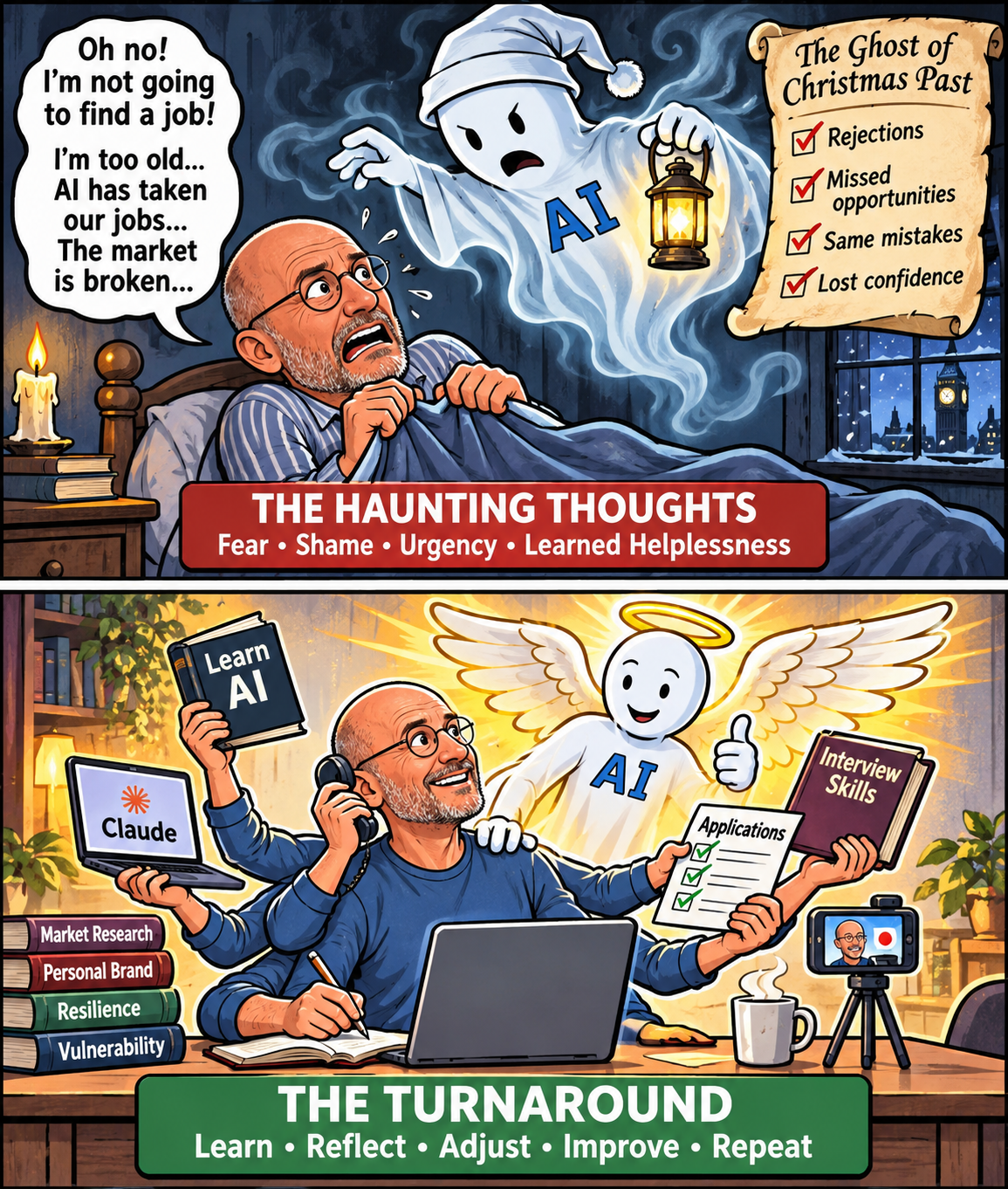
The illustration embedded at the start of this article draws on a Dickensian metaphor that resonated deeply throughout my search.
When you are stranded in prolonged unemployment, you are shadowed by a haunting ghost. It whispers constantly about catastrophe: that you are too old, that the industry has passed you by, that algorithmic gatekeepers have permanently locked you out, that artificial intelligence has made your life’s work irrelevant. It feeds on rejection notices and converts every setback into evidence of personal failure.
For months, I allowed that ghost to sit in the corner of my workspace, dictating my mood, spiking my cortisol, and paralyzing my decision-making.
The turning point was not an external miracle. It was transforming my relationship with the very forces that frightened me.
The right-hand side of that image represents the guiding light of deliberate adaptation. The very technology I once feared—frontier artificial intelligence—became the tireless partner that helped me dissect complex job specs, interrogate my own blind spots, practice difficult conversations, and master modern concepts.
AI did not find me a job. AI did not write my applications. It did not replace my hard-won four decades of engineering judgement.
Instead, it served as an intellectual mirror. It helped strip away defensive habits, exposed weak explanations, and allowed me to show up to interviews as a modern, curious, adaptable engineer rather than an embittered veteran clinging to legacy accomplishments.
The technology you fear can become the instrument that enables your reinvention.
Part IX: Reinvention and Outcome
Eighteen months after that devastating HR meeting, at the age of sixty-two, I accepted an offer for an exceptional role in central London.
The organisation was young, fast-moving, and ambitious. The work placed me directly at the frontier of artificial intelligence, building complex agentic systems and modern engineering workflows alongside deeply talented, motivated colleagues decades younger than myself. The office was within walking distance of my home.
The contrast between the start of my journey and its conclusion was stark:
- At the beginning: Paralysed by fear of redundancy, ashamed of unemployment, defensive about age, bewildered by modern hiring pipelines, and viewing AI as an existential career threat.
- At the conclusion: Energised by daily technical problem-solving, operating fluently with frontier AI architectures, collaborating with a brilliant team, and possessing a renewed sense of professional vitality.
I want to be completely honest: I cannot promise that following this framework guarantees an immediate, storybook outcome.
Timing, macro-economic conditions, geography, serendipity, and individual company requirements all play significant roles. I did not possess a crystal ball when I started studying AI architectures late into the night. There were weeks when progress felt non-existent and quitting felt like the only rational choice.
What I can state with absolute confidence is this:
Waiting for the market to revert to how it used to be is a guarantee of permanent stagnation. Repeating the same generic applications while stewing in resentment compounds exhaustion.
Deliberate learning, rigorous self-assessment, honest communication review, and an iterative feedback loop dramatically tilt the odds in your favour. They transform you from a passive victim of market disruption into an active competitor capable of creating value in a changing world.
Part X: Your Immediate Action Plan
If you find yourself in the thick of this struggle today, do not try to fix everything by tonight. Take a deep breath, close the thirty open job tabs, and execute this five-stage sequence:
1. Stabilise (Secure the Foundation)
- Establish an accurate, unvarnished picture of your finances and runway.
- Cut non-essential burn immediately.
- Explore interim contracting, consulting, or part-time revenue to ease financial pressure.
- Build a sustainable daily routine: fixed sleep hours, daily physical exercise, and strict boundaries around job searching. Do not allow the search to consume all 16 waking hours.
2. Assess (Audit Capabilities Honestly)
- Separate your demonstrated strengths from your genuine technical and communication gaps.
- Separate capability deficits (need to build/study) from presentation deficits (need to communicate impact).
- Clarify precisely what type of business problems you are best equipped to solve.
3. Investigate (Read the Market)
- Select twenty current job descriptions in your target field.
- Analyze them for recurring architectural patterns, tooling expectations, and underlying commercial friction.
- Identify the transferable bridges between your decades of foundational experience and the modern problems organisations are trying to solve.
4. Prepare (Build the Evidence Arsenal)
- Rebuild your CV around concrete outcomes, business impact, and verifiable decisions.
- Record yourself answering standard interview questions on video. Review the footage with ruthless objectivity.
- Use AI as an adversarial sparring partner to pressure-test your explanations and challenge weak arguments.
- Build small, working demonstrations of modern tooling to prove currency.
5. Execute and Learn (The Feedback Loop)
- Submit tailored, high-signal applications rather than spraying generic resumes.
- Log every meaningful interaction in a lightweight tracker.
- Treat every interview—successful or unsuccessful—as a diagnostic experiment to extract data.
- Execute one specific improvement each week.
Responsibility Without Self-Blame
I know how exhausting this journey is.
I know what it feels like to wake up at 3:00 AM with your heart racing, calculating your remaining savings, wondering how you will explain your situation to people you care about, and feeling the bitter sting of automated rejection notices.
If that is where you are sitting today, hear this clearly:
You are not broken. Being made redundant is an economic event; it is not a moral verdict on your intelligence, your capability, or your human worth. You do not bear the blame for global market cycles, corporate reorganisations, or broken recruiting systems.
But you hold complete ownership over your response.
You can choose to be haunted by a changing world, or you can choose to study it, adapt to it, and master it.
You cannot control who calls you back today. But you can control what you learn, how you practice, how you communicate, and how you show up tomorrow.
At sixty-two, after hundreds of rejections, I found the most intellectually rewarding work of my entire career.
Not because the obstacles magically disappeared. But because I finally stopped waiting for the world to change, and learned how to change myself.