LLM Coding Drift is Mathematically Guaranteed
The Hidden Cost of High Accuracy
Software quality has an immediate upfront cost, but poor quality keeps charging the business whenever the product needs to evolve. For a system expected to live beyond its next few releases, predictability is the most practical business value that engineering quality provides.
This is precisely why measuring developer productivity—and now AI coding productivity—is notoriously difficult. Tech debt always surfaces late and offbeat, where its initial cause is obscured by time.
When developers build with Large Language Models, we often evaluate capability using single-turn prompts, short completions, or isolated benchmark tests. A model boasting a 99% accuracy rate on individual code completions feels near-flawless.
However, when LLMs solve complex, multi-step engineering tasks—generating full feature implementations, refactoring multi-file modules, or executing autonomous workflows—they do not process the entire sequence at once. They predict text one token at a time, where every step depends strictly on the tokens generated before it.
Under this autoregressive architecture, coding drift isn’t an occasional quirk or an alignment flaw. It is mathematically guaranteed.
The Mathematics of Geometric Decay
To understand why autonomous coding sessions degrade over longer sequences, consider the law of compound probability.
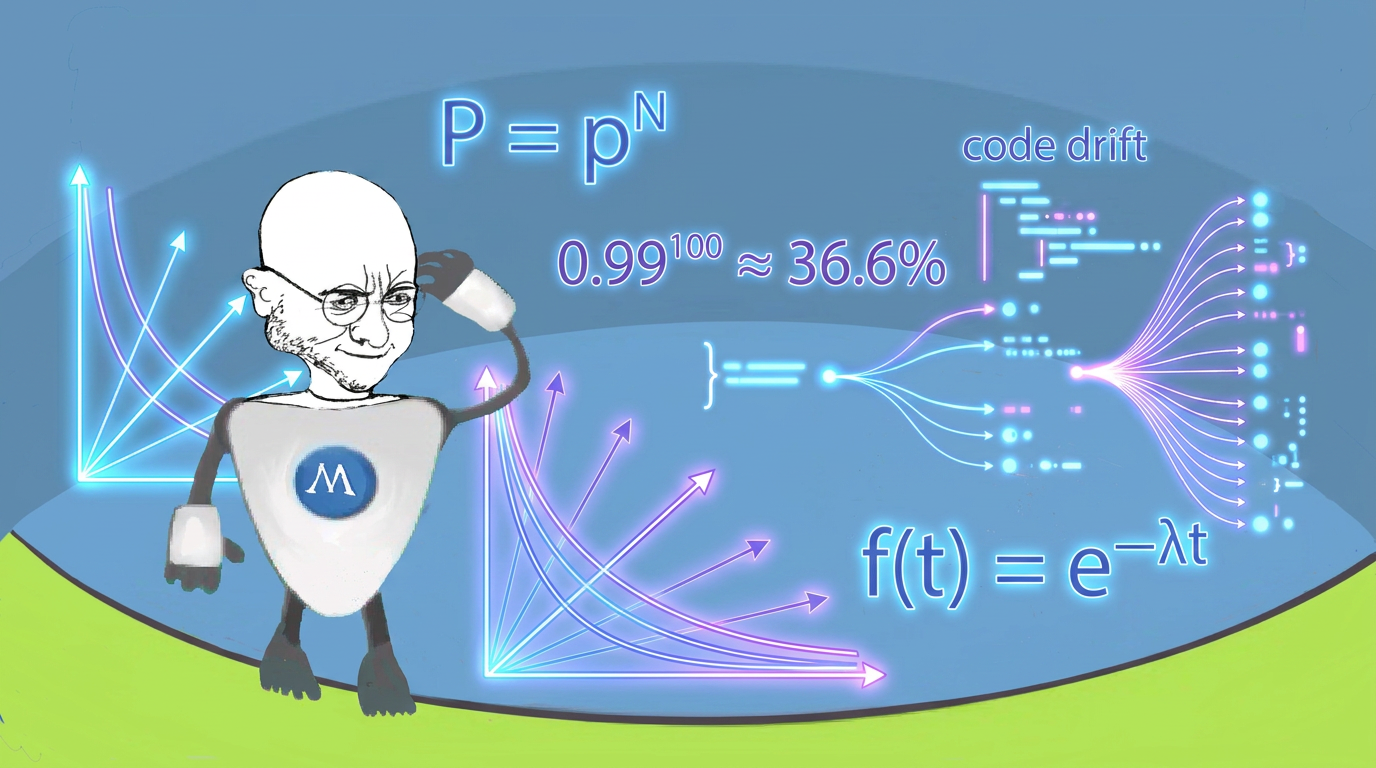
If an LLM performs an N-step reasoning or generation process, and each step carries an accuracy rate p, the overall probability P(success) of completing the sequence without error is governed by exponential decay:
P(success) = p^N
Even with an extraordinarily high single-step accuracy of 99% (p = 0.99), the math unfolds relentlessly over an extended sequence:
- Step 1 Accuracy: 0.99¹ = 99.0%
- Step 10 Accuracy: 0.99¹⁰ ≈ 90.4%
- Step 50 Accuracy: 0.99⁵⁰ ≈ 60.5%
- Step 100 Accuracy: 0.99¹⁰⁰ ≈ 36.6%
[Step 1: 99%] ──► [Step 10: 90.4%] ──► [Step 50: 60.5%] ──► [Step 100: 36.6%]
By step 100, a model that is “99% reliable per step” becomes correct less than 40% of the time for the whole sequence.
What appears on paper as near-perfect accuracy degrades into coin-flip reliability over fifty operations, and guaranteed failure over a hundred.
Error Propagation: When Missteps Become Ground Truth
The exponential decay of raw probability is only half the problem. The secondary issue lies in error propagation.
Because an LLM operates in an autoregressive loop, it uses its prior output as the immutable context for its next output:
- A slight, subtle mistake in Step 2 doesn’t remain isolated inside Step 2.
- In Step 3, the model treats that initial hallucination or flawed premise as absolute ground truth.
- By Step 5, the model is actively reasoning on top of a false foundation.
- By Step 20, the entire implementation suffers from structural collapse.
Step 1: Valid Premise
   └─► Step 2: Micro-error (1% drift)
          └─► Step 3: Treats error as Absolute Truth
                 └─► Step 50: Complete Architectural Drift
In human terms, this is not a simple typo; it is logical hallucination built upon unexamined assumptions.
Analogies That Make Drift Concrete
To build intuition for how small margins of error turn into systemic failure, consider three everyday mental models:
1. The Misaligned Compass
If you set off on a 1,000-mile trek and your compass is off by just 1 degree, you don’t miss your target by a few yards—you miss your destination by 17 miles. Early trajectory errors compound linearly in distance and exponentially in complexity.
2. The Game of Telephone
Even if each participant transmits 98% of a sentence correctly to the next person, by the time the message passes through 10 people, the final output bears almost no resemblance to the original thought.
3. A House of Cards
Every generated token is a card stacked on top of the previous one. A microscopic tilt in a card near the foundation guarantees that the upper floors will collapse under their own weight.
The Quality Paradox and Testing as Friction
This mathematical reality highlights a fundamental insight about software engineering: most of the value of writing tests comes from the friction experienced while writing them.
When engineers write tests, they are forced to interact directly with the APIs they just built. They feel the ergonomics, uncover hidden coupling, and catch edge cases early. The green checkmark in CI is secondary; the primary benefit was the active design feedback loop.
When an LLM generates hundreds of lines of code in a single prompt, it skips that feedback loop entirely unless explicit validation gates are enforced. It builds smoothly on top of its own unverified outputs, oblivious to the growing probability of underlying structural failure.
Engineering for an Autoregressive World
If geometric decay is mathematically guaranteed, how do we build reliable AI-driven software workflows?
The solution is not to wait for a 100% accurate model—which is a statistical impossibility in probabilistic systems—but to architect workflows that interrupt error propagation:
- Shorten the Sequence (N): Decompose large tasks into tightly bounded, atomic operations rather than asking a model to complete complex multi-file implementations in a single pass.
- Deterministic Verification Gates: Place hard, deterministic checks (unit tests, linters, type checkers, compiler passes) between steps. Passing a test resets the error propagation chain back to zero.
- Explicit Context Pruning: Clean the context window regularly. Do not allow speculative reasoning or superseded attempts to contaminate the prompt state.
- Human-in-the-Loop Boundaries: Require explicit verification at high-leverage architectural boundaries before allowing an agent to proceed with downstream implementation.
By controlling sequence length and enforcing hard verification boundaries, we tame compound probability—turning mathematically guaranteed drift into a predictable, robust engineering workflow.