The Myth of Linear Scale: What the '1,000x Developer' Teaches Us About Architectural Leverage
The Industrial Premise of Modern Management
Modern software management rests on an inherited, industrial intuition: intellectual work scales linearly with capital.
If an engineering initiative falls behind schedule, conventional corporate logic dictates adding personnel. Double the headcount, double the velocity; deploy ten times the budget, compress delivery by an order of magnitude.
This operational philosophy treats software architecture as an assembly line. Yet software construction is fundamentally not a volume exercise—it is an exercise in pure abstract logic and interconnected state.
Decades ago, Fred Brooks dismantled this assumption in The Mythical Man-Month, observing that adding human capital to a late software project inherently delays it further. In contemporary engineering discourse, conversations frequently circle around the elusive “10x engineer”—a contributor whose disciplined execution outpaces an average team.
However, examining the technological infrastructure underpinning digital civilization reveals an entirely different tier of leverage: the 1,000x developer.
These are singular architects who, working largely in isolation with standard hardware, conceived foundational platforms, unlocked entire industries, and rewrote the operating logic of modern computing. Analyzing their breakthroughs dismantles comfortable enterprise assumptions about scaling, management synchronization, and the true origins of foundational innovation.
The Cognitive Synchronization Tax
To understand how an isolated individual can outpace an enterprise department, one must examine the hidden tax of multi-contributor engineering: communication overhead.
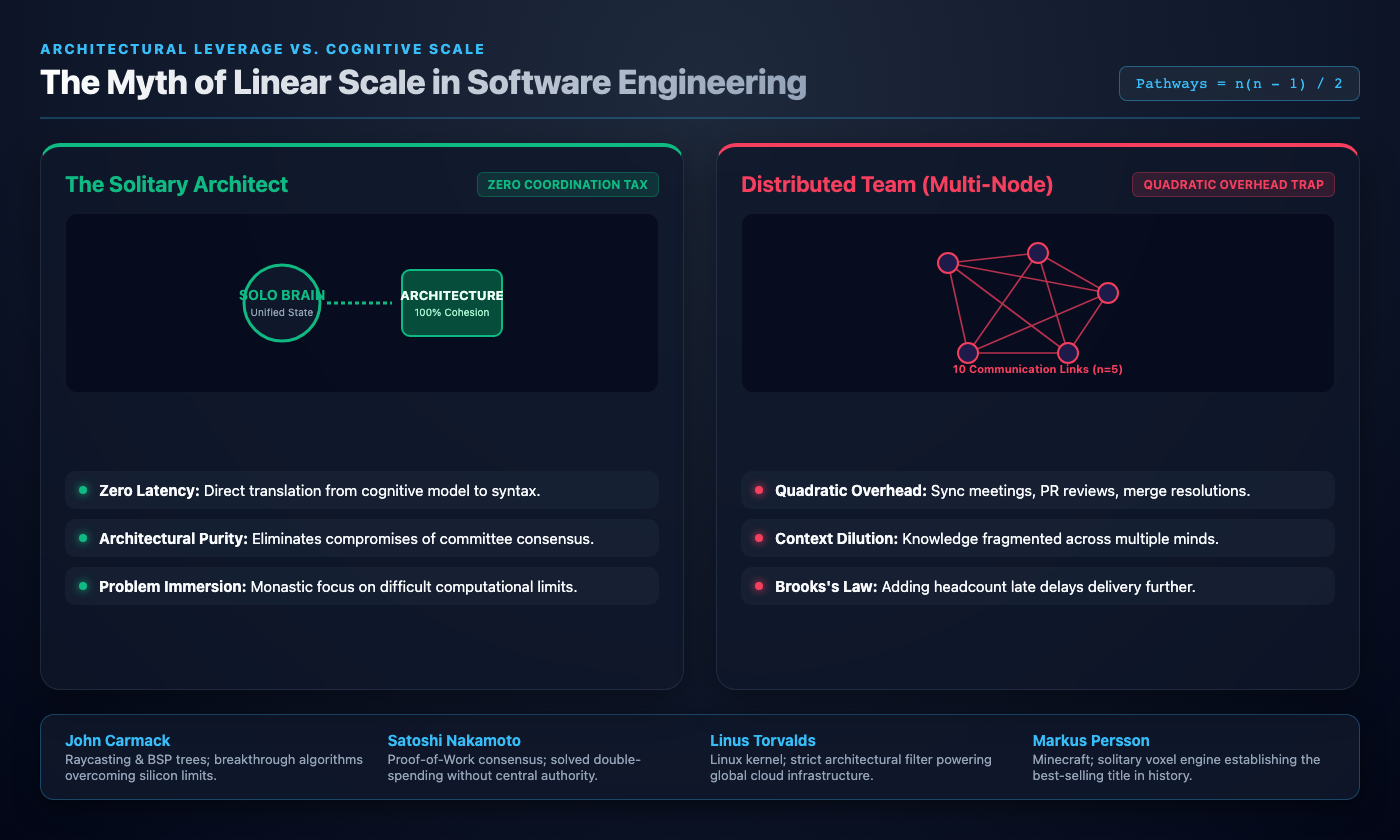
When a solitary engineer designs a complex system, the entire mental model—every state mutation, edge case, dependency, and variable lifecycle—remains synchronized within a single cognitive frame. There is zero latency between architecture design and implementation.
The moment a second engineer joins the initiative, a communication channel is established:
Nodes (n) = 2  →  Pathways = 1
Nodes (n) = 5  →  Pathways = 10
Nodes (n) = 10 →  Pathways = 45
The mathematical formula governing unique communication links between $n$ contributors is quadratic:
$$\text{Pathways} = \frac{n(n - 1)}{2}$$
As team size scales linearly, the communication pathways explode quadratically.
Engineers must spend increasing fractions of their cognitive energy synchronizing mental models, resolving merge conflicts, translating requirements, documenting interfaces, and conducting architectural consensus meetings.
Beyond a critical threshold, coordination effort directly eclipses productive development. Software quality degrades from a unified aesthetic into an assemblage of negotiated compromises.
The solitary architect bypasses this synchronization penalty entirely, operating at the raw speed of internal thought.
Market Execution vs. Architectural Manifestation
Technology analysis frequently conflates commercial operators with foundational system architects. Figures like Bill Gates and Mark Zuckerberg built staggering commercial empires, but their primary genius lay in ruthless strategic execution within established market trajectories.
By the time Facebook emerged, social networking was already an active, heavily validated paradigm (Friendster, Myspace). The market trajectory was clear; had Zuckerberg chosen another path, historical momentum and venture capital incentives would have inevitably surfaced an equivalent platform.
By contrast, the 1,000x developer operates on an orthogonal vector. They do not analyze market demand or optimize conversion funnels. Instead, they look at a technical void and construct unprecedented computational primitives.
Without their specific, idiosyncratic intervention, these breakthroughs might have been delayed by decades—or manifested in fundamentally different, fragmented forms.
| Vector | The Business Executor (10x Multiplier) | The Foundational Architect (1,000x Multiplier) |
|---|---|---|
| Primary Driver | Market capture, distribution, capital scaling | Technical problem-solving, internal aesthetic coherence |
| Methodology | Agile sprints, team delegation, consensus | Monastic isolation, deep immersion, zero coordination overhead |
| Market Vector | Riding validated industry momentum | Manifesting solutions before the market realizes the need |
| Output | Commercial enterprise, high enterprise valuation | Fundamental technological infrastructure, paradigm shifts |
Four Case Studies in Extreme Leverage
Examining four legendary cases illustrates how individual autonomy, extreme focus, and idiosyncratic motivations bypassed traditional organizational mechanics.
Case 1: Mathematical Illusion over Raw Power — John Carmack
In 1992, the personal computing landscape was functionally two-dimensional. Graphics were restricted to side-scrolling platformers where sprites traversed fixed X and Y coordinates. The silicon of the era lacked the processing power to compute true three-dimensional floating-point math in real time.
John Carmack did not wait for hardware manufacturers to catch up. Instead, he pioneered raycasting algorithms and binary space partitioning trees that forced 16-bit and 32-bit processors to simulate spatial geometry, depth, lighting, and line-of-sight calculations. The resulting engines—powering Wolfenstein 3D and Doom—effectively broke visual reality out of flat space and invented the architectural blueprint of modern real-time 3D graphics.
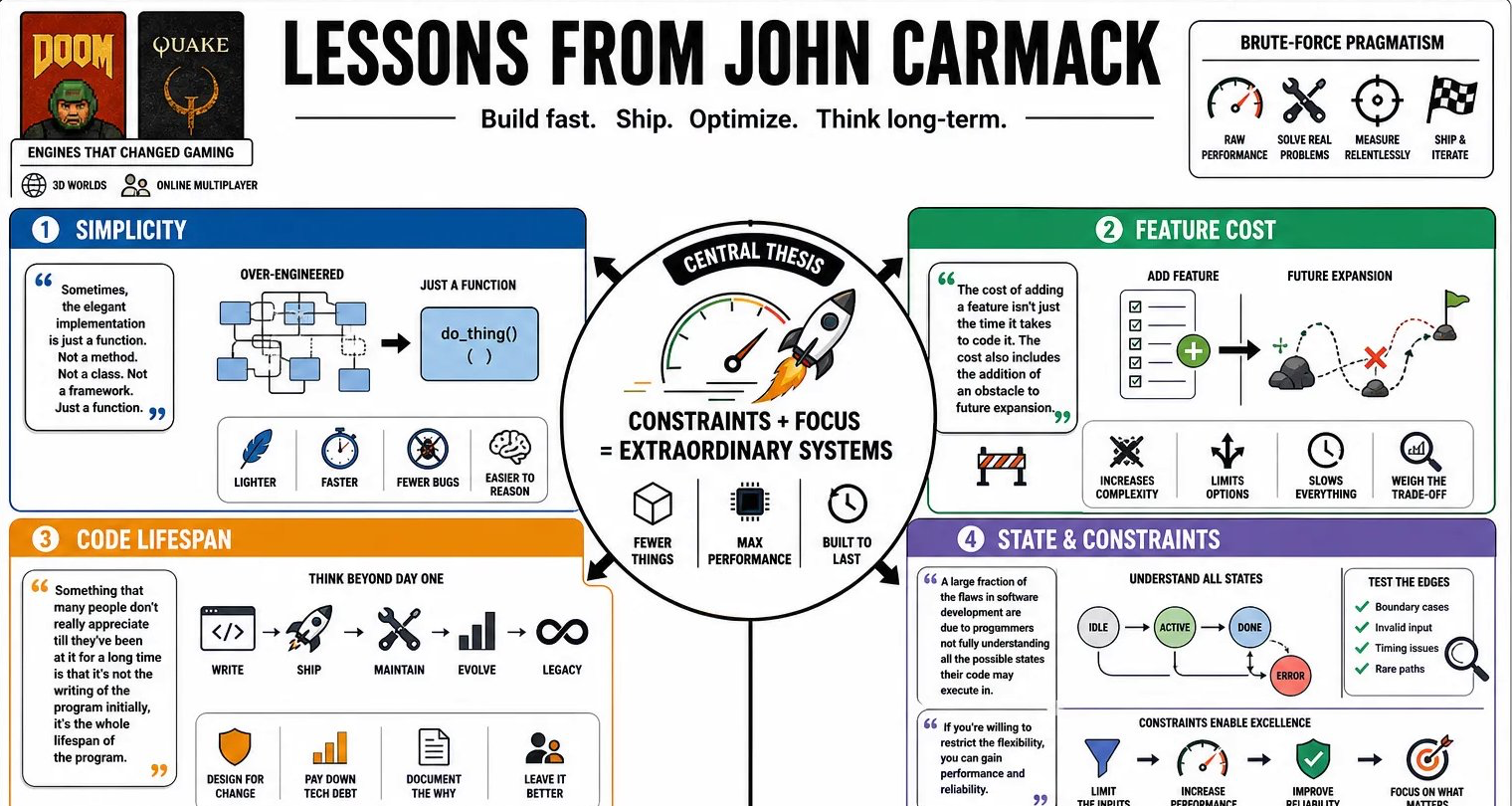
Carmack’s leverage stemmed directly from a disciplined engineering philosophy: Constraints + Focus = Extraordinary Systems. While modern teams accumulate layers of speculative abstractions, Carmack operated with brute-force pragmatism:
- Radical Simplicity: “Sometimes, the elegant implementation is just a function. Not a method. Not a class. Not a framework. Just a function.” Stripping away speculative scaffolding kept the engine lightweight, fast, and mentally parseable within a single developer’s head.
- Restricting Flexibility to Master State: Carmack recognized that most software failures stem from developers failing to model all possible execution states. By intentionally restricting runtime flexibility and rigidly constraining state boundaries, he unlocked raw hardware throughput and deterministic reliability.
- Accounting for the Full Lifecycle: Carmack noted that the real cost of a feature is never the initial afternoon spent coding it—it is the ongoing friction and permanent obstacle it creates for future expansion across the entire lifespan of the system.
Simultaneously, Carmack and id Software bypassed traditional distribution choke points. Rather than relying on physical disk manufacturing and retail shelf space, they distributed episodic chunks of their software across early digital bulletin board networks under a shareware framework—a functional ancestor of the modern direct-to-consumer software-as-a-service model.
Carmack’s incentive was not wealth maximization (his eventual net worth remained a modest fraction of the multi-billion-dollar industry he sparked); it was an unyielding obsession with the computational limits of the processor.
Case 2: Cryptographic Consensus without Authority — Satoshi Nakamoto
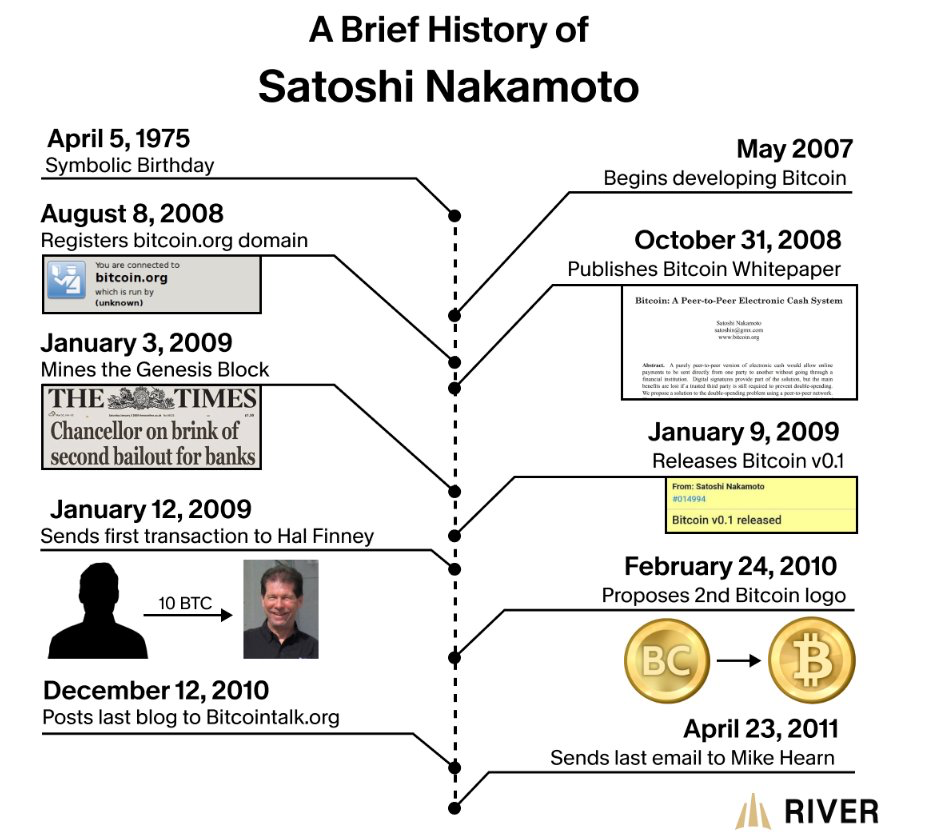
Between 1992 and 2008, cypherpunks attempted to design decentralized digital currency (e.g., B-Money, Bit Gold). Every iteration stalled against the fundamental computer science barrier: the Double-Spending Problem. Without an intermediary bank to maintain an authoritative ledger, digital data could simply be duplicated and spent twice.
In 2008, an anonymous developer (or collective) operating under the pseudonym Satoshi Nakamoto published a nine-page white paper resolving a sixteen-year stalemate. The breakthrough did not rely on central institutional trust, but on mathematical consensus: Proof-of-Work.
By tying ledger validation to computationally intensive mathematical puzzles (where solving is difficult, but peer verification is instantaneous), Nakamoto automated trust across untrusted networks.
Nakamoto’s subsequent disappearance in 2010 was an intentional architectural choice. Retaining a corporate figurehead or foundation introduces a central point of failure—an office to raid, a CEO to subpoena. By abandoning an untouched wallet holding over one million bitcoins and vanishing, Nakamoto removed the bouncer from the door, leaving behind a self-sustaining mathematical architecture.
Case 3: The Benevolent Dictator and the Invisible Backbone — Linus Torvalds
In 1991, Linus Torvalds was a Finnish university student frustrated with the limitations and licensing constraints of the educational MINIX operating system. Rather than working within existing frameworks, he wrote a foundational operating system kernel from scratch.
A kernel is the lowest software layer of an operating system—the translation layer between abstract instructions and physical silicon, governing memory allocation, thread scheduling, and hardware I/O. Torvalds made the kernel open-source, allowing developers globally to construct customized distributions around it (Debian, Ubuntu, Red Hat, Arch).
Today, the Linux kernel is the unseen substrate of global computing:
- Powers all 500 of the world’s top supercomputers.
- Serves as the base OS for Android, running on billions of mobile devices.
- Drives the overwhelming majority of cloud infrastructure, enterprise servers, and IoT nodes.
Paradoxically, Torvalds managed the largest collaborative open-source project in history driven by a stated desire to avoid direct interpersonal friction. He maintained kernel integrity through an uncompromising management style, rejecting traditional corporate diplomatic norms in favor of strict technical criteria.
While that bluntness drew persistent criticism and ignited debate regarding developer culture, Torvalds viewed his abrasive technical filter as a necessary bulwark against poor architectural compromises that could destabilize global infrastructure.
Case 4: The Monolithic Sandbox and Cultural Exhaustion — Markus Persson (Notch)
Markus Persson built Minecraft as a solitary programmer, writing a simple voxel-based sandbox engine in Java. He offered players no pre-scripted narratives or explicit objectives, merely an infinitely generating terrain governed by simple mechanical rules.
The game became an unprecedented cultural phenomenon and the best-selling video game in history. But Notch remained fundamentally a hobbyist programmer, wholly uninterested in executive corporate stewardship.
When the pressures of managing an immense global platform collided with his desire to remain an unfiltered internet commentator, the psychological strain culminated in the sale of Mojang to Microsoft in 2014 for $2.5 billion.
Persson’s trajectory illustrates the vulnerability of the lone architect: when an isolated creation reaches global scale, corporate and cultural forces demand that the author morph into a sanitized corporate symbol. Refusing that transformation resulted in an acrimonious split, culminating in his complete corporate and social erasure from his own creation.
The Unifying Anatomy of Radical Leverage
When synthesized, the profiles of true 1,000x architects reveal patterns that directly contradict modern venture-backed startup dogma:
- Indifference to Conventional Market Viability: None of these systems originated from customer discovery calls, TAM (Total Addressable Market) calculations, or pitch decks. They were born out of personal intellectual friction—a stubborn determination to overcome a technical limitation.
- Architecture Over Capital Extraction: The goal was solving the structural puzzle. Wealth creation was a downstream side effect, not the primary feedback loop.
- Zero-Coordination Velocity: Working unencumbered by consensus, these builders maintained complete architectural purity throughout the initial design phase, allowing radical paradigms to emerge intact rather than rounded off by committee compromise.
When an engineer builds solely for market demand, they remain constrained by what the market can currently imagine. By stepping entirely outside existing commercial frameworks, singular architects frequently build what the world desperately needs, but lacked the technical vocabulary to request.
The Horizon of Zero-Cost Execution
We are entering an inflection point that upends this dynamic once again. As generative models and programmatic AI tools democratize code generation, the technical cost of transcribing abstract logic into syntax is rapidly trending toward zero.
This shift presents a critical question for technology leaders and software engineers:
Will this explosion of synthetic leverage trigger a golden era of solo developers building world-shifting platforms uninhibited by corporate bureaucracy? Or will the static of auto-generated, homogenized code drown out the idiosyncratic brilliance required to construct truly original foundations?
The answer will not be found in hiring sprees or bloated roadmaps. The history of computing suggests that the next paradigm shift will not be delivered by a thousand-person committee.
It will emerge from an isolated workstation, where an individual rejects standard compromises, tunes out the noise of the market, and solves a problem simply because they refuse to tolerate its broken state.