Three Minutes to Mental Clarity: Biological Hormesis and the Leverage of AI
The Ritual of 6.8°C
6.8°C. Three minutes.
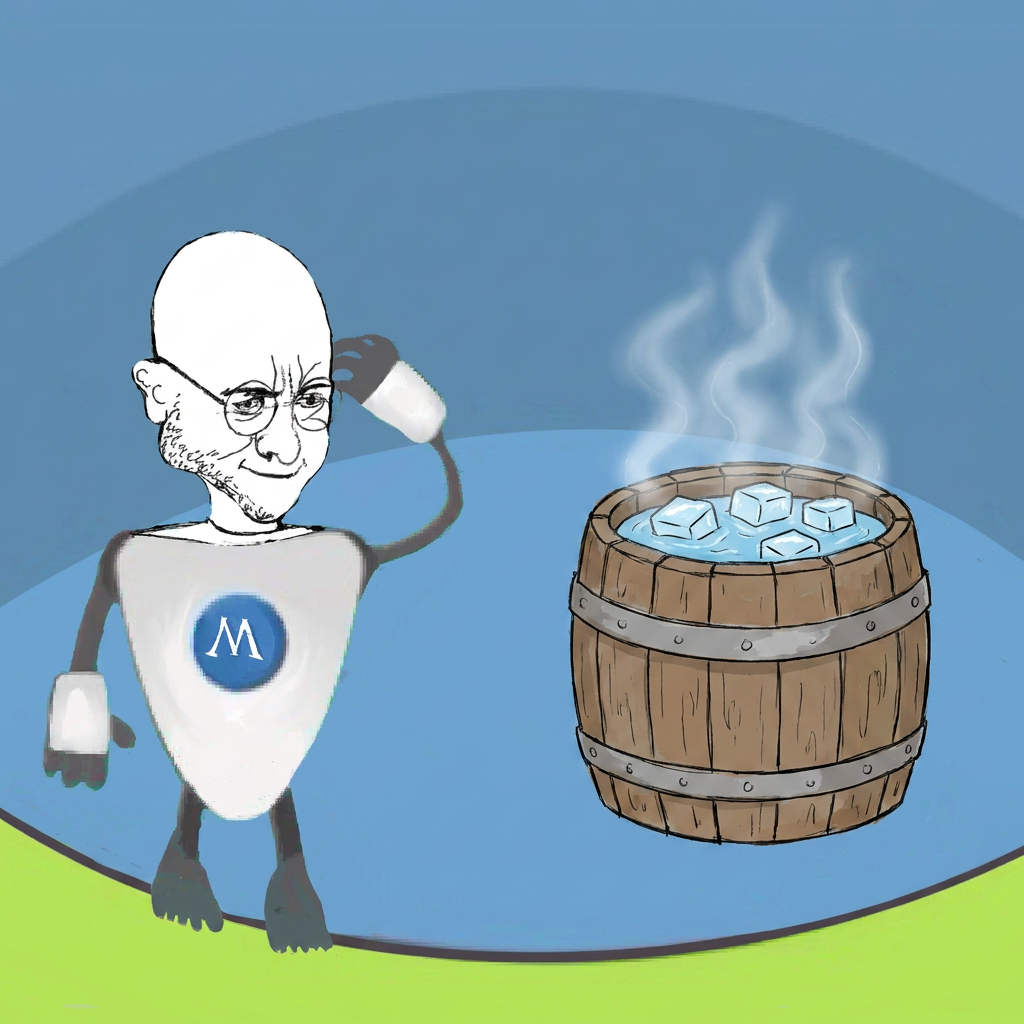
Every morning, I stand before my custom cold exposure setup, and every morning, a familiar mental friction occurs. The human brain is a highly evolved survival engine designed to seek comfort, conserve energy, and avoid thermal shock. Stepping into near-freezing water goes against every basic survival instinct we possess.
People often ask me why I still bother with cold exposure.
The answer isn’t because I enjoy being cold. It isn’t. The three minutes themselves are a test of willpower, a deliberate exercises in breathing through acute physical discomfort.
I do it because I enjoy what happens afterwards.
The moment you step out, your system is flooded with a profound cocktail of norepinephrine and dopamine. Your vascular system constricts and dilates. The fog of sleep is instantly shattered, replaced by a deep, vibrating alertness and a razor-sharp mental clarity. My brain properly wakes up, primed and focused for the day’s engineering challenges.
But the cold plunge doesn’t happen by accident.
I built my own exposure tub. It needs maintaining. It requires filtration, temperature regulation, and a small, unyielding ritual of preparation before those three minutes can ever happen. Like any worthwhile habit, it demands consistency.
And that is where the real realization lies: The three minutes aren’t the investment. The investment is building and maintaining the system that makes those three minutes repeatable, day after day.
As an engineer, that concept feels deeply familiar.
The best systems we build aren’t the ones that completely eliminate human effort. They are the ones that make our effort highly leveraged and worthwhile.
The Principle of Hormesis
In biology, there is a fundamental concept known as hormesis. It is the phenomenon where a low, controlled dose of an environmental stressor (like extreme cold, heat, fasting, or intense exercise) triggers a powerful, adaptive survival response.
Instead of damaging the organism, this brief, deliberate exposure to stress activates cellular repair, strengthens mitochondrial function, and builds systemic resilience.
Comfort / Stagnation ───► System Atrophy
Deliberate Stress (Hormesis) ───► Adaptive Strengthening & Cognitive Clarity
We live in an era obsessed with frictionless comfort. We want instant delivery, automated temperatures, and seamless interfaces. But in biology and in intellect, unmitigated comfort leads directly to atrophy. If you never stress a muscle, it wastes away. If you never stress your intellect, your capacity for complex reasoning begins to decay.
This is exactly how I now think about AI.
AI as an Experience Amplifier
At 62, I am often asked how I view the massive wave of generative AI and autonomous coding agents sweeping through our industry. Many senior engineers look at these tools with skepticism, fearing that they trivialize the discipline, erode core skills, or make decades of hard-won experience obsolete.
I see it as the exact opposite. I do not see AI as replacing experience. I see it as amplifying it.
When I co-program with an agent to refactor a complex Python library, the AI does not supply the architectural vision. It does not provide the historical context, the instinct for responsibility boundaries, or the qualitative judgment required to balance design trade-offs. Those assets cannot be synthesized on the fly; they are the distilled, hardened products of decades spent solving real-world failures.
What the AI gives me is incredible leverage.
It handles the administrative syntax, the boilerplates of testing frameworks, and the tedious translations of API contracts. It acts as a tireless, ultra-fast junior partner that lets me explore more alternative designs, pressure-test constraints, and simplify complex code bases faster than I could have imagined just a few years ago.
The Growth Loop
Neither the cold plunge nor the AI does the actual thinking for me.
The cold water doesn’t solve my architectural problems—it merely creates the biological state of clarity that allows me to solve them. Similarly, the AI doesn’t write perfect software on its own—it requires my skeptical supervision, my test-driven constraints, and my qualitative direction to produce durable, maintainable systems.
Both require active, disciplined engagement. Both are systems of leverage that demand consistency to yield their true value.
Perhaps that’s the real lesson of my morning routine. Whether we are discussing physical health, software engineering, or cognitive performance, growth rarely comes from comfort. It comes from deliberately building systems that make growth repeatable.
Experience doesn’t become less valuable with age. Given the right tools, the right systems, and the right habits, it becomes more valuable than ever.