Vectors as Ephemeral Indices: Architectural Patterns for Semantic Search
The Vector Database Anti-Pattern
As generative AI and Retrieval-Augmented Generation (RAG) mature, vector databases have exploded in popularity. Platforms like Qdrant, Pinecone, and Milvus are now standard components of the modern enterprise stack.
However, a dangerous architectural anti-pattern has emerged: treating the vector database as a primary database and source of truth.
Engineers are frequently seen writing application pipelines that ingest raw documents, embed them into vectors, and store both the vectors and the entire document payloads exclusively inside a vector collection.
This approach is highly fragile. A vector database is not designed to be your canonical system of record.
If you design your architecture around the premise that your vector store is the durable truth of your data, you will eventually face a painful, systemic collapse. To build a resilient semantic search system, we must establish a clear separation of responsibilities: your vector database is an ephemeral search index, not a primary database.
The Core Concept: Ephemeral Indices
To understand why a vector database is a search index, we must look at the nature of vector embeddings.
A vector is not a universal representation of text. It is a highly specialized, dense numerical representation generated by a specific neural network (the embedding model, such as OpenAI’s text-embedding-3-small, or local models like bge-large-en-v1.5).
Because of this, vectors are inextricably tied to the exact model that created them.
Original Document (Durable Truth)
        │
        ├─► Model A ──► Vector A (Only comparable with Model A vectors)
        └─► Model B ──► Vector B (Only comparable with Model B vectors)
If you decide to upgrade your embedding model to a newer, more efficient version, or switch from a cloud API to a local model for privacy compliance, your entire vector database instantly becomes obsolete. You cannot compare vectors generated by Model A with vectors generated by Model B; they exist in entirely different geometric latent spaces.
If you have discarded the original, raw text or treated the vector store as the sole source of truth, you cannot upgrade your system.
The canonical source of truth must reside in a durable database (such as MongoDB, PostgreSQL, or a flat-file directory of Markdown files). Your vector store is a derived, ephemeral artifact. If you swap models, your controller should be able to wipe the vector collections and rebuild them entirely from the primary source.
Separating Responsibilities: The Decoupled Pipeline
To maintain architectural clean lines, our pipelines should enforce a strict boundary between three distinct domains:
- The Canonical Data Store (e.g., MongoDB): Stores the raw, durable records.
- The Embedding Toolkit: Generates dense vector representations from text. It knows about API keys, model dimensions, and chunking strategies.
- The Vector Persistence Toolkit (e.g., Qdrant): Stores, indexes, and queries numeric arrays. It treats vectors as completely opaque arrays of floating-point numbers and has absolutely zero knowledge of how those vectors were generated.
Original Document (MongoDB)
            │
            ▼
   embedding_toolkit  ◄─── Generates opaque numerical array
            │
            ▼
     qdrant_toolkit   ◄─── Manages collections & indices
            │
            ▼
    Qdrant Database
By keeping the Qdrant persistence layer blind to the embedding model, you prevent tight coupling. Your database toolkit doesn’t need to change or be re-released when you swap your embedding model; it simply continues to receive and index numerical arrays.
Human-Designed vs. Learned Latent Vectors
When designing semantic search, it helps to understand the fundamental difference between human-designed feature vectors and learned latent embeddings.
Human-Designed Feature Vectors
Historically, we built feature vectors by manually defining explicit fields that represented real-world concepts:
[
  "app_problem",       // Dimension 0 (Boolean/Float)
  "delivery_problem",  // Dimension 1 (Boolean/Float)
  "financial_concern", // Dimension 2 (Boolean/Float)
  "urgency"            // Dimension 3 (Float)
]
In this setup, every dimension has an explicit, human-readable meaning. If dimension 2 is 1.0, we know the document involves a financial complaint.
Learned Latent Vectors
Modern embedding models generate vectors where meaning is distributed across hundreds or thousands of latent dimensions (e.g., 1536 dimensions for standard OpenAI embeddings).
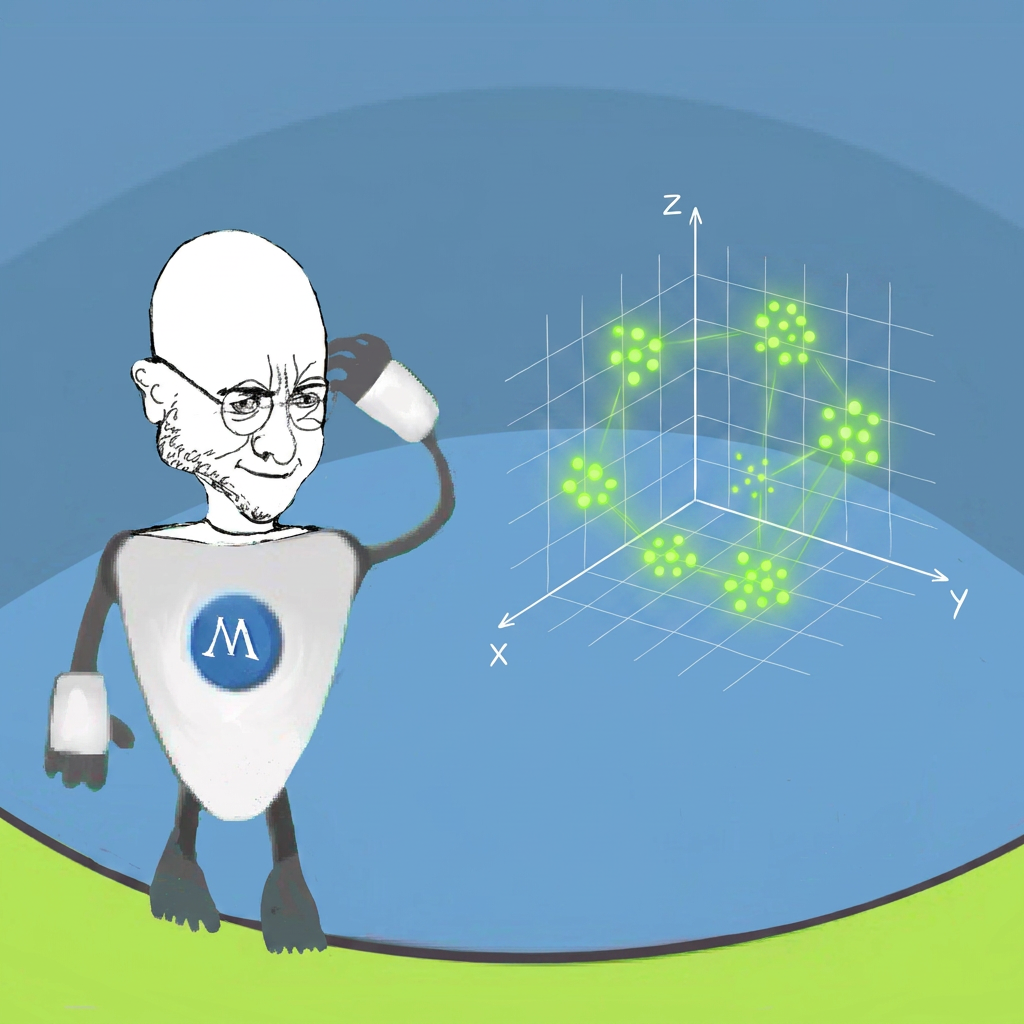
No single dimension corresponds to a concept. Dimension 412 has no human-readable meaning. Instead, semantic relationships are represented geometrically: concepts that are semantically similar are positioned close to each other in a multi-dimensional hyperspace.
Designing for Multi-Mode Storage
A well-designed vector toolkit (like our procedural qdrant_toolkit) should support three distinct storage modes to make local development, unit testing, and production scaling frictionless:
- In-Memory Mode (
:memory:): Great for fast, deterministic unit testing. It spins up an ephemeral Qdrant database in RAM, runs tests, and discards it, ensuring tests are isolated and have zero side-effects. - Embedded Persistent Disk Mode (
path="./qdrant_data"): Perfect for local development, manual experimentation, and offline debugging. It writes the vector collections directly to local files on your machine without requiring a running Docker container or a cloud connection. - Server Mode (
url="http://localhost:6333"): The production deployment target, connecting to a dedicated Qdrant server cluster.
The Model Migration Workflow
Because vectors are ephemeral, changing an embedding model is not a simple configuration swap—it is a migration event. A resilient architecture handles this migration using a choreographed blue-green collection deployment:
By implementing this index regeneration pattern, your system gains absolute technical independence. You are never locked into an obsolete model, and your data remains infinitely upgradable.
Build your pipelines with a clear division of responsibilities: keep your durable truth canonical, treat your vectors as derived assets, and let your vector database do what it does best—act as a high-performance, ephemeral search index.